Get Full Government Meeting Transcripts, Videos, & Alerts Forever!
Get email alerts on the Housing topic
No spam. Unsubscribe anytime.
Commission recommends rezoning on Notch Road to allow two Habitat for Humanity affordable homes
Summary
The Albemarle Planning Commission recommended rezoning a 0.603-acre Crozet parcel from R-2 to R-4 to allow two fee‑simple duplex units to be sold at restricted affordability; Habitat for Humanity and staff said both units would be affordable but for 30 years (staff noted Housing Albemarle recommends 40 years), and commissioners urged zoning code modernization to expand small-scale options countywide.
The Albemarle County Planning Commission voted to recommend rezoning a 0.603-acre Crozet parcel on 3 Notch Road from R‑2 to R‑4, clearing the way for two for‑sale duplex units proposed by Habitat for Humanity of Greater Charlottesville.
Principal planner Cameron Landgel told commissioners the Crozet master plan recommends neighborhood density residential (3–6 units per acre) and that the applicant’s conceptual plan would produce two units outside the mapped stream buffer. Landgel said staff found the request consistent with the master plan and recommended approval, but noted Housing Albemarle’s preference that for‑sale affordable units remain restricted for 40 years; the proffers for this project commit to a 30‑year affordability term.
Amy George, representing Habitat, explained the request to rezone to R‑4 so each duplex could be sold on fee‑simple lots. Dan Rosenzweig, president and CEO of Habitat for Humanity of Greater Charlottesville, told the commission Habitat’s average buyer households in recent years have been at about 34 percent of area median income (AMI) and that Habitat typically serves households at 25–60 percent AMI; the proffer range offered is 25–80 percent AMI to provide flexibility so homeowners who increase earnings while in the program do not violate zoning limits.
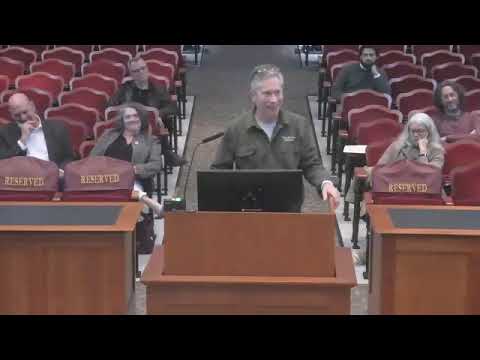
Residents at the hearing voiced mixed reactions: Mary Jane Gore, who owns the adjacent house, asked about setbacks, fencing, driveway widths and the potential for future access to the rear of the parcel; David Farrell, a nearby property owner who said he supports affordable housing, warned that rezoning sets a precedent that could drive up assessments and taxes for modest nearby homes.
Habitat staff answered technical questions: the units would be fee simple, divided along a party wall with a fire‑rated wall and air gap; Habitat said it operates an EXUP escrow program to collect funds for shared exterior maintenance so repairs do not fall solely on individual homeowners.
A commissioner moved to accept staff's recommendation; the motion carried on voice vote with recorded ‘Aye’ votes from Mister Bivens, Mister Moore, Mister Carzana and Miss Firehawk. The planning commission will forward its recommendation to the Board of Supervisors for final action.
Commissioners repeatedly raised the broader policy point that the county’s zoning modernization effort should consider allowing small‑scale accessory units, duplexes or other missing housing types in R‑2 areas to expand affordable options.