Get Full Government Meeting Transcripts, Videos, & Alerts Forever!
Get email alerts on the Land Use topic
No spam. Unsubscribe anytime.
Planning commission backs Funk Brothers' plan to reopen former Moose Lodge as craft shop
Summary
Albemarle County planners recommended approval of a special-use permit allowing Funk Brothers Furniture to reuse a vacant Moose Lodge building for a craft and antiques shop, with conditions addressing nonconforming setbacks and screening; commissioners praised reuse and asked staff to fold 'artisan manufacturing' considerations into upcoming zoning revisions.
Albemarle County Planning Commission members voted to recommend approval of a special-use permit allowing Funk Brothers Furniture to move into a vacant former Moose Lodge and operate a craft and antiques shop.
Senior planner Jared Tate told the commission the roughly 3-acre parcel at the northeast corner of Richmond Road and Moose Lane is currently vacant and includes a nonconforming structure that sits as close as about 17 feet to an adjacent residence. Tate said staff found the proposal consistent with the comprehensive plan and Section 33.4 review criteria and recommended approval with five conditions, while noting the setback nonconformity as the primary concern.
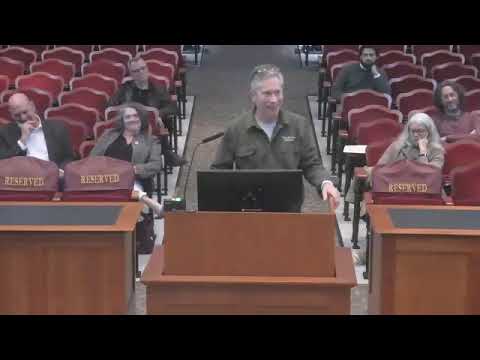
Applicant Mike Funk said he and a partner will occupy separate halves of the building and that Funk Brothers’ operations will be located in the half farthest from neighbors. "We, we're craftsmen. We fix things … we use local materials," Funk said, describing a mostly hand‑based operation and plans to restore the property after a decade of vacancy.
Commissioners asked about ownership, parking and potential community uses. Funk said the large former Moose Lodge parking area could support occasional events such as weekend farmers markets and described voluntary measures including a proposed 50‑foot buffer between the applicant’s active workspace and adjacent residential property and an internal firewall to separate halves of the building.
Public advocate Connor O'Donnell, who had worked with the applicants, urged the commission to treat this case as evidence of a larger gap in the county’s code: makers and artisan manufacturers lack clear allowances in rural zoning. Several commissioners echoed that point and asked staff to carry artisan‑manufacturing considerations into the ongoing zoning code rewrite.
A commissioner moved to recommend approval with the conditions listed in staff’s report; the motion was seconded and the clerk recorded voice votes of "Aye" from Miss Firehawk, Mister Carzana, Mister Moore and Mister Bivens. The commission’s favorable recommendation will be forwarded to the Board of Supervisors for final action.
The commission also rescheduled a work session to December 9 at 4 p.m. and adjourned the evening’s business.