
Student ex officio presents survey showing mixed reaction to district's distraction-free phone policy
Get AI-powered insights, summaries, and transcripts
Subscribe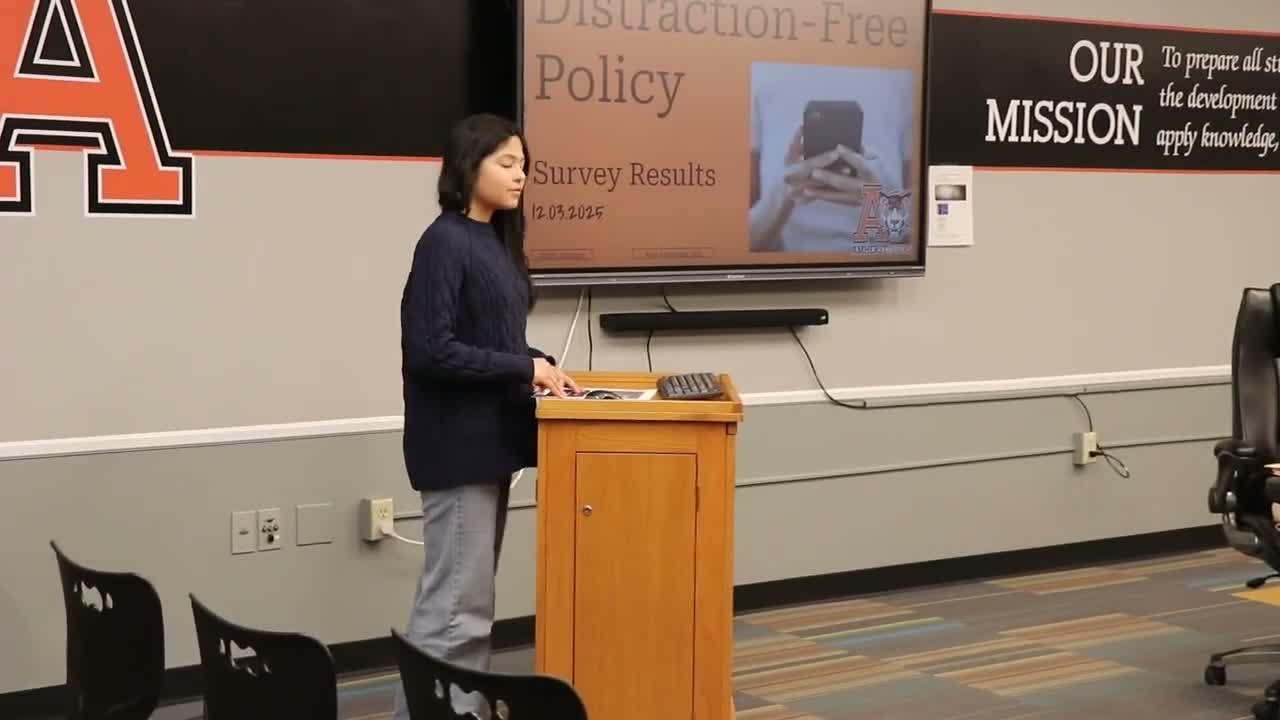
Summary
Student board member Olivia Hidalgo reported results from a Google Form survey of 371 students: most respondents did not say they felt less distracted, many reported feeling less connected to peers and some reported increased anxiety; board members said they will monitor and may survey again after one year of implementation.
Olivia Hidalgo, the student ex officio board member, presented results from a Nov. 19'Nov. 26 Google Forms survey of 371 students about the district's distraction-free cell phone policy. Hidalgo said freshmen were the largest respondent group (134); sophomores and juniors each supplied 89 responses and seniors 59.
Main findings: Hidalgo said respondents generally did not report feeling less distracted at school; however, many students said they felt less connected to peers and reported increases in anxiety. "They said no. They didn't feel less distracted," Hidalgo told the board. She also reported that 170 respondents "strongly agreed" that they felt less connected to peers and that 134 "strongly agreed" they felt more anxious or upset under the policy.
Method and limits: Hidalgo said the survey was available via Chromebooks and that some students received the invitation directly from her rather than through the district's Aspen system, which may have produced a freshman-heavy sample. Board members noted that an overrepresentation of freshmen could skew perceptions of behavioral change and discussed repeating the survey in spring to see whether opinions shift with longer implementation.
Reaction and next steps: District staff said they have seen fewer phones in hallways and in some classrooms since implementation. The district plans to keep customizable elements of the policy under review and to revisit the issue after one year of implementation, including the level of consequences and storage procedures.