
Bannock County commissioners hear how new battery storage could bolster reliability and curb peak costs
Get AI-powered insights, summaries, and transcripts
Subscribe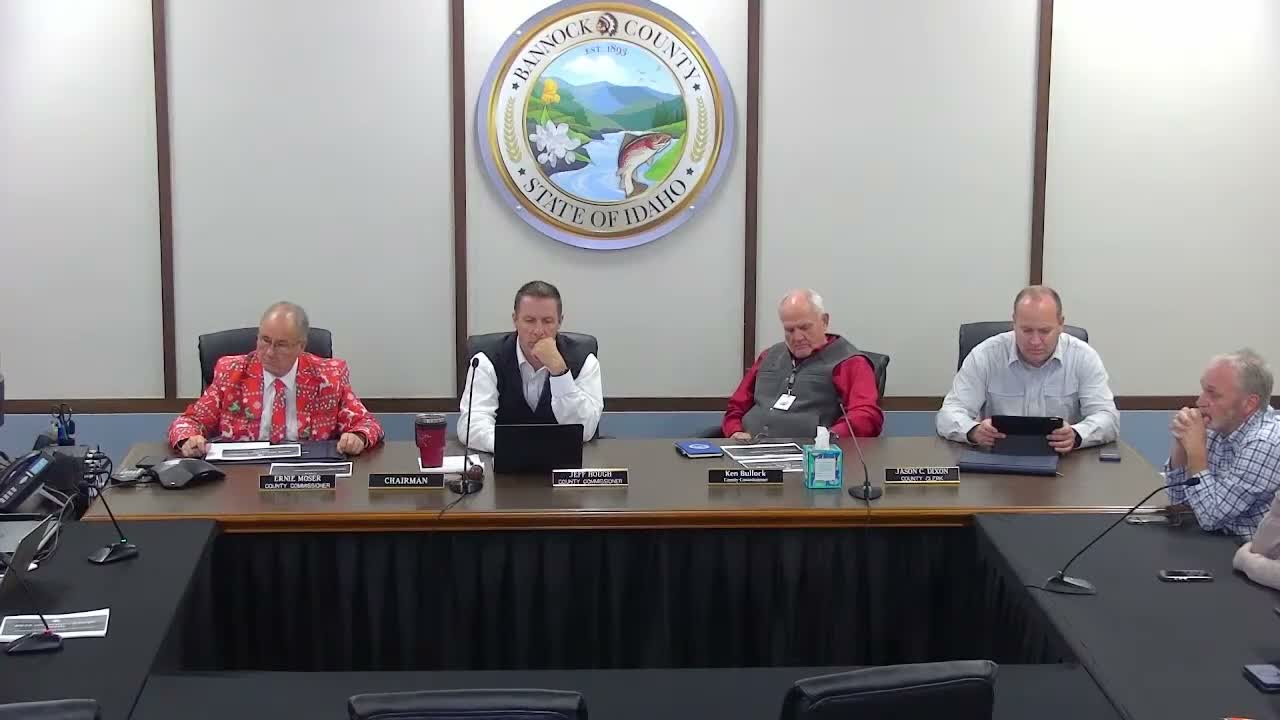
Summary
At an informational session, Renewable Northwest and RWE presenters described how lithium-iron-phosphate battery systems work, safety features and testing results, and urged county officials to consider ordinance language requiring compliance with standards and emergency-response planning.
Presenters at a Bannock County Board of Commissioners informational session on battery energy storage on Dec. 20, 2025, told commissioners the technology can help meet rapidly growing electricity demand while offering safety features not present in earlier systems.
Aaron Menenburg, Idaho policy manager for the nonprofit Renewable Northwest, told the commissioners the state faces ‘‘front-loaded’’ demand growth and that "these next coming 5 years of demand growth is the same as the last 40 years of demand combined," a trend he said makes storage important to keeping electricity reliable and affordable. Menenburg framed the issue as part of Idaho Power’s 20-year integrated resource planning process and said county land-use decisions can affect the utility’s ability to serve roughly 637,000 customers in its service territory.
Scott Rinsley, senior director of development, US West, for developer RWE, explained the technology in plain terms: "it's a giant battery," he said, distinguishing current lithium iron phosphate (LFP) systems from earlier lithium-ion chemistries. Rinsley described modular units with ‘‘touch safe’’ interfaces and duplicate remote panels at site entry so first responders can read state-of-charge and temperature without entering the enclosure. He said systems are monitored 24/7 from regional operations centers.
Rinsley said modern safety and containment features limit the extent of failure. He summarized destructive testing done with third-party labs: when a single module was forced to fail and ignited under test conditions, the fire consumed only that module with a maximum flame roughly "2 and a half feet" high and about 3 feet wide, and the unit remained repairable. He added that modules are designed to be removed and replaced by a technician and that operators typically plan to redeploy or recycle modules once they reach about 80% of original capacity.
On emergency response, Rinsley recommended developers and counties require an emergency services response plan, annual training, and objective permitting criteria tied to recognized standards. He listed standards and codes in common use — UL, IEC, IEEE and NFPA 855 — and suggested the county could require proof of compliance as part of an ordinance. He also described community benefit practices developers use to equip and train local fire departments, including providing thermal imaging cameras, UTVs or four-wheel-drive vehicles and maintaining an on-site 30,000-gallon water tank with 24-hour access for local fire authorities.
Commissioners pressed on specifics: how long the current generation of systems has been in use (Rinsley said roughly three to four years), failure and end-of-life handling (design life cited at about 30–40 years; retired modules go to second-use markets or recyclers) and firefighting protocol (Rinsley said responders often let a burning module burn out while cooling adjacent modules). Rinsley agreed to provide testing reports and video to the board through Renewable Northwest.
The session was informational; no formal actions or votes were taken. The presentations and question-and-answer session left several next steps for commissioners if they choose to regulate or permit battery projects: obtain Idaho Power IRP data for cost/reliability tradeoffs, decide specific zoning setbacks and footprint requirements, and consider ordinance language requiring proof of standards compliance and emergency-response coordination.