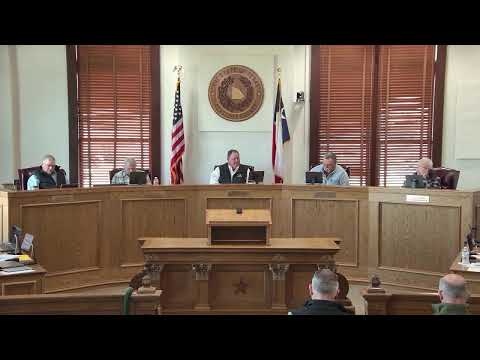
Atascosa County adopts 287(g) task-force model; sheriff cites local control and federal reimbursement
Loading...
Summary
Sheriff Garrett briefed the court on adopting the 287(g) 'task force officer' model that trains deputies to work with DHS/ICE on criminal‑immigration enforcement, emphasizing sheriff discretion and federal reimbursement for deputy hours and equipment; the court approved the agreement and budget line creation.
Sheriff Garrett and Chief Kaiser described the county’s planned participation in the 287(g) reimbursement program and asked the Atascosa County Commissioners Court to approve the county’s adoption of the task‑force officer model on Dec. 8.
Sheriff Garrett said the program is not voluntary for counties with jails under recent state direction and that the chosen model — the task force officer model — offers the county greater authority and discretion to pursue criminal immigration cases tied to drugs, human smuggling, gang activity and other serious offenses. "This is not a voluntary thing. Governor Abbott signed this into law," the sheriff said in briefing the court.
Officials explained the model’s operational details: trained deputies will be able to take limited federal enforcement actions and transfer individuals to ICE; federal funds will reimburse deputies’ salary/hours and provide equipment funding, and the county will seek reimbursement for time deputies spend on 287(g) activity. Chief Kaiser said the county currently has four task force officers and about 20 more deputies in the training pipeline, which would bring the roster to 24 officers; the sheriff’s office said additional deputies could be added later.
Speakers emphasized local discretion: the sheriff said the county decides when and where to run task‑force operations and that participation would not automatically result in housing non‑state‑charged federal detainees in the county jail. County legal staff and the sheriff’s office discussed procedures for coordination with DHS/ICE and faster transfer processes once federal custody is requested.
Commissioner Gillespie moved to approve the agreement and create the specified budget line for 287(g) reimbursement; a second was recorded and the motion carried. The transcript records the court’s approval but contains no roll‑call vote tally.
No public comments on the agreement were recorded during the meeting.