
Arlington Board directs manager to craft FY2027 budget amid revenue shortfalls
Get AI-powered insights, summaries, and transcripts
Subscribe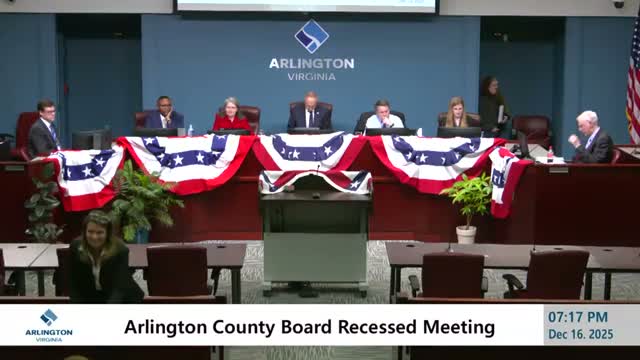
Summary
Facing weaker consumption and real‑estate receipts, the Board unanimously directed the County Manager to prepare a balanced FY2027 proposal that prioritizes protections for vulnerable residents, considers revenue options (including tax and fee changes), and fully funds collective bargaining agreements.
Arlington County's Board on Dec. 16 unanimously approved a set of budget guidance directing the County Manager to prepare a balanced FY2027 proposed budget in light of revenue softness.
Board members cited weaker consumption tax receipts and lower real‑estate‑related revenue in the current fiscal year, noting gaps of roughly $8 million (consumption) and about $5 million (real‑estate) versus adopted projections. The guidance asks the manager to present options that include reductions, delays of capital projects, efficiency measures, and revenue measures such as adjustments to the real‑estate tax rate, business and personal property tax adjustments, meals tax, parking enforcement changes, and targeted fee increases.
The Board emphasized two priorities: fully funding collective bargaining agreements (already addressed in a separate resolution at the meeting) and protecting vulnerable residents. The guidance instructs staff to include options that avoid disproportionate impacts on residents facing housing, food and health insecurity, and to present funding options for affordable housing, eviction prevention, permanent supportive housing and safety‑net programs. It also directed inclusion of programmatic updates for mental‑health services, climate implementation, childcare and Vision Zero work.
Manager and staff said they are already slowing nonessential hiring, delaying discretionary capital where possible, and will report on one‑time funding balances (including stabilization funds) and multi‑year approaches to use those reserves.
The motion to adopt the written guidance passed unanimously.