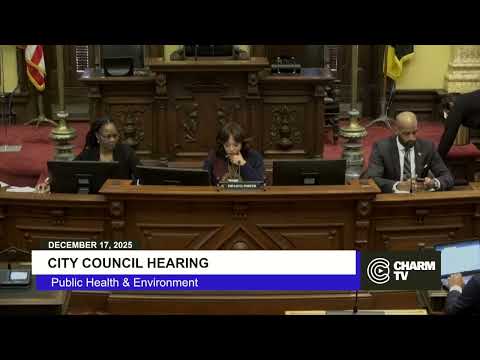
Committee advances Bill 25-0096 to ease residential disabled parking permit rules
Loading...
Summary
The Baltimore City Council Public Health and Environment Committee voted to advance Bill 25-0096, which would remove annual physician certification and neighbor-signature requirements for reserved residential disabled parking permits, replace them with a five-year recertification and require biennial reminder notices. The bill passed committee and moves to second reader on Jan. 12, 2026.
At a committee meeting, the Baltimore City Council Public Health and Environment Committee voted to advance Bill 25-0096, a measure the sponsor said would reduce barriers for residents with disabilities seeking reserved residential street-parking permits. The committee approved a technical amendment recommended by the Law Department and sent the bill to second reader on Jan. 12, 2026.
Councilman Parris Gray, the bill sponsor, framed the measure as a practical change to make accessibility reliable for residents who depend on vehicles. "Access delayed is access denied," Gray said, summarizing the bill's intent to remove unnecessary paperwork and confidentiality risks for permit holders.
The ordinance would remove the annual physician-signed medical certification, eliminate the neighborhood-approval signature requirement, institute a five-year recertification that allows residents to confirm status by mail or electronically without physician involvement, and require the Baltimore City Parking Authority to send reminder notices every two years. Gray also offered a technical amendment that replaces the phrase "work person" with "individual," which the Law Department recommended for clarity.
Advocates and residents who testified said the changes address real obstacles. Daria Pugh, an attorney with Disability Rights Maryland, told the committee the neighbor-signature requirement and renewal burdens deter applicants and raise confidentiality concerns. "Baltimore is the only jurisdiction in Maryland that imposes this excessive burden," Pugh said, and she urged the committee to remove a fee-related provision (section 9-15(b)) from the code because Title II of the Americans with Disabilities Act forbids governments from charging fees for reasonable modifications.
Resident testimony underscored everyday impacts. Kim Stevens, a homeowner and permit holder on Andover Avenue, described difficulty obtaining neighbor signatures after neighbors moved or houses became vacant: "If I needed to do that all over again, it will be difficult for me to get the signatures," she said.
Agencies reported no legal or substantial fiscal obstacles. Desiree Leckey of the Law Department said the office approved the bill "for form and legal sufficiency" and noted a typographical correction. Gabriel Stewart Sikowitz of the Finance Department said the city expects no fiscal impact and deferred to the Parking Authority on implementation. Michelle Thompson of the Parking Authority said the authority's internal turnaround to process an application and conduct a site review is generally about 30 days; she added that, once a work order is submitted, the Department of Transportation typically takes four to six weeks to install signage or markings. Christian McNeil of DOT said DOT deferred to the Parking Authority on policy and offered no recommendation. Zachary Wallman of the Office of Equity and Civil Rights said the bill would simplify a process that had become a barrier for many residents and recommended a favorable report.
On the committee floor, members voted first on the technical amendment and then on the bill as amended. Roll call showed Councilwoman Felicia Porter, Councilman Mark Conway, Councilman Mark Parker, Councilman Ryan Dorsey, and Councilman John Bullock voting in favor; Councilmen Torrance and Ramos were absent for both votes. The amendment passed; the final vote passed, and the bill was scheduled for second reader at the full council meeting on Jan. 12, 2026. The committee adjourned after the vote.
What happens next: the bill will appear on the council calendar for second reader on Jan. 12, 2026. If approved there and on subsequent readings required by council rules, the ordinance would change administrative procedures for issuing and renewing reserved residential disabled parking permits in Baltimore City.