Get Full Government Meeting Transcripts, Videos, & Alerts Forever!
Get email alerts on the Housing Zoning topic
No spam. Unsubscribe anytime.
Baltimore committee advances major zoning overhaul to allow 2–4 unit homes citywide; debate sharpens over displacement and process
Summary
The Land Use and Transportation Committee heard presentations and extensive public testimony on council bill 250066, which would permit 2–4 unit "low-density multifamily" homes by right across many residential zones. Agencies generally supported the bill; planning recommended a three-year monitoring report. The committee did not take final action and will return with requested data and amendments.
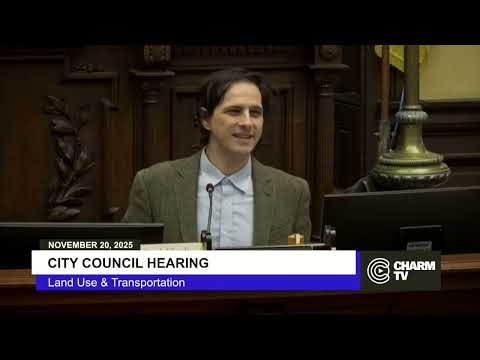
Chair Ryan Dorsey convened the Land Use and Transportation Committee to consider council bill 250066, the Housing Options and Opportunity Act, on behalf of the mayor—s administration. Tyler Schnella, deputy director of government relations for the mayor, called the legislation "a key part of the mayor's broader $3,000,000,000 plan to fight vacant properties, expand affordability, and make Baltimore City a city where everyone can find a home that fits their needs." The administration framed the proposal as a way to expand the "missing middle" of housing and to reduce barriers that have historically limited multifamily options in many neighborhoods.
Planning staff gave a technical overview: the bill creates a new land use, "multifamily low density" (two to four units), and permits that use by right in R1A through R8 and certain office-residential districts. Eligibility would be determined by gross floor area, not lot area, with thresholds set at roughly 1,500 square feet for two units, 2,250 for three units and 3,000 for four units (basement area excluded). Planning explained the change is intended to reduce the number of variances and conditional-use ordinances required under the current code and to rely on building-size controls rather than lot-area rules.
The hearing turned to process and equity. Vice President Sharon Green Middleton said constituents worry the change is "rushing" and cited experiences with discrimination and neighborhood instability; she asked how the bill would avoid oversaturation of rentals and preserve neighborhood character. Schnella and planning staff repeatedly answered that the bill would not change federal protections for group homes and that it—s designed to "enable" conversions rather than force them. Planning and the mayor—s office said they will monitor outcomes and proposed amendments; the Planning Commission recommended a three-year study and reporting requirement so the council can reassess policy effects.
Multiple agencies filed favorable reports. The law department approved the bill for form and legal sufficiency but flagged potential legal questions about whether the package could be treated as comprehensive rezoning (a point raised repeatedly by public commenters). The Department of Finance, DHCD, DOT and BMZA generally supported the bill, noting it reduces regulatory hurdles that now push some rehabilitations into informal or unsafe conversions.
Public testimony was extensive and sharply divided. Opponents including several neighborhood associations, Community Law Center and individuals warned that the change could invite speculative—often out-of-town—investment, accelerate displacement in historically disinvested neighborhoods and disproportionately affect areas without private deed covenants that protect wealthier neighborhoods. "This bill will reduce homeownership opportunities," said a neighborhood leader who identified herself as Marita Goodman and asked the council to slow the process. Supporters such as Healthcare for the Homeless and local YIMBY groups countered that allowing legal, code-compliant conversions would bring vacant buildings back to productive use, increase affordable options and reduce homelessness risk.
The committee did not vote on final passage. Members asked agencies to produce additional empirical data (historic conversion patterns, owner-occupancy after conversion, mapping of unpermitted conversions and unlicensed rentals, and the incidence of deed covenants) and sought more detail on enforcement capacity and code-inspection staffing. Planning and the administration committed to provide additional datasets and to return with drafted amendments and monitoring language. The Planning Commission—s recommended three-year monitoring report was noted as a prospective amendment.
Next steps: the committee will reconvene with agency responses, proposed DLR amendments and the planning-commission language before taking a final vote. No formal enactment or final council vote occurred during this session.