Get Full Government Meeting Transcripts, Videos, & Alerts Forever!
Get email alerts on the Lake Ecology topic
No spam. Unsubscribe anytime.
Study: Carp removal helps vegetation and food web but not lakewide water quality
Summary
A Utah State University fish biologist presented monitoring (2009–2024) showing reduced carp biomass coincided with more shoreline plant species and stronger zooplankton and fish condition, but overall nutrient concentrations and submerged-vegetation densities have not declined.
A Utah State University fish biologist presented long-term monitoring results showing that the program to remove common carp from Utah Lake has produced measurable ecological benefits — notably more shoreline vegetation species, greater zooplankton and insect prey, and improved body condition in June sucker and sport fish — but has not yet produced measurable improvements in lakewide water quality.
"We've also seen a positive response in the food web," the presenter said, reporting increases in preferred prey (zooplankton and aquatic insects) and fatter fish following reductions in carp biomass. The monitoring covers the period 2009 through 2024 and, according to the presenter, recorded the lowest carp biomass around 2017–2019 before a modest uptick in recent years.
The findings come from standardized shoreline and ecosystem sampling carried out by the presenter’s lab in collaboration with the June Sucker Recovery Program, the Division of Water Quality and the Division of Wildlife. The presenter said the team has "removed many tons of total phosphorus" as part of their work but added, "we have not seen, improvements in water quality," attributing the persistent nutrient concentrations to multiple ongoing nutrient inputs to the lake.
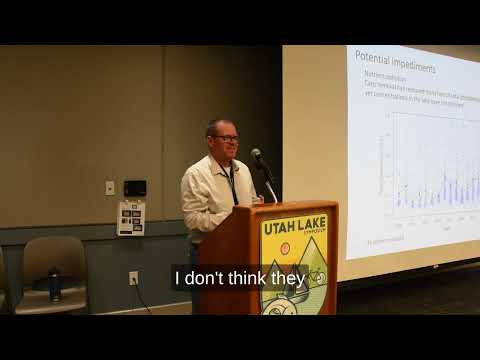
The team documented an increase in the number of aquatic-vegetation species found at shoreline sampling sites during low-carp periods, and a corresponding improvement in prey availability for young and sport fish. "Here on the x axis, we have sampling year; on the y, we have carp biomass in millions of kilograms," the presenter said while describing the trend — language that pointed to year-by-year sampling through 2024 and a notable low-biomass interval centered on 2017–2019.
At the same time, statistical analysis showed that submerged, emergent vegetation and species richness decline significantly as lake level drops. The presenter emphasized that variability in lake level — "where the lake level was a month ago, 2 months ago, or a year ago" — may matter more than the instantaneous level when sampling occurs. Recent relative stability in lake level, the presenter said, coincided with observed patches of submerged aquatic vegetation in Provo Bay.
Those observations led the presenter to identify three main challenges for further ecosystem improvement: suppress carp populations further and maintain that suppression; reduce nutrient inputs from wastewater and other sources; and reduce lake-level fluctuations, a difficult goal because the impounded lake serves as important water storage for many users.
The presenter concluded that combining sustained carp removal with active nutrient-reduction efforts offers the best prospect for more substantial water-quality and vegetation gains, but cautioned that extreme lake-level swings could make vegetation establishment temporary. The presentation noted ongoing and future analyses, including an undergraduate thesis project to investigate lake-level timing effects on vegetation.
The presenter acknowledged collaborators, including the June Sucker Recovery Program, Scott Daley at the Division of Water Quality, staff in the Division of Wildlife, Russ Franklin of the water conservancy district, and Addie and Marley from the Utah Lake Authority. The monitoring dataset used in the presentation spans 2009–2024 and the presenter said further work was underway to refine nutrient-removal totals.