Get Full Government Meeting Transcripts, Videos, & Alerts Forever!
Get email alerts on the Carp Removal topic
No spam. Unsubscribe anytime.
Utah State researcher: carp removal in Utah Lake has stalled; models show 510times effort needed to meet biomass target
Summary
Tim Walzworth of Utah State University told the Utah Lake Authority that carp biomass fell early in the removal program but has stabilized above the programs 75% reduction target; model simulations indicate reaching the target likely requires a sustained 510-fold increase in historical seining effort or alternative measures such as genetic techniques or pricing incentives.
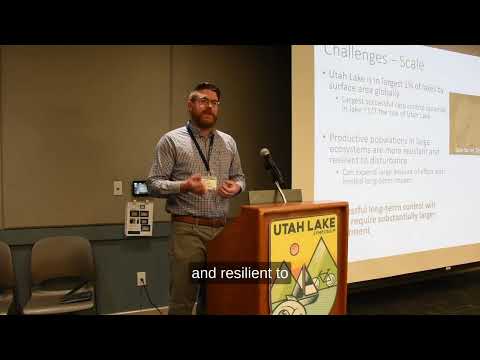
Tim Walzworth, an assistant professor of fish ecology and fisheries management at Utah State University, told the Utah Lake Authority that long-running carp removal efforts have reduced carp biomass from historic highs but appear to have stalled above the programs target. He said the June Sucker Recovery Implementation Program began mechanical removal in 2009 with commercial seining and, to date, "we've got 13,000 tons of carp" (about "30,000,000 pounds"), but the lake still contains more carp than managers would like.
Walzworth emphasized that "removing carp isn't the goal" by itself; the objective is to reduce carps ecological effects on habitat and prey available to native fish such as the June sucker. He described the method used to estimate carp abundance: because sampling gears primarily catch larger, older fish, the team uses a statistical catch-at-age model and multi-year size data from the commercial fishery and standardized surveys run with the Utah Division of Wildlife Resources (UDWR) and the June Sucker program to infer numbers of younger, often unseen, age classes.
The biomass record, Walzworth said, shows a sharp decline in the programs early years through roughly 20172018, followed by stabilization and a slow increase since then. He attributed that stall to several interacting factors: the lakes large, shallow, and productive habitat that favors carp; gear selectivity that misses smaller but reproductively mature fish; periodic high lake levels that expand spawning and rearing habitat while reducing seine efficiency by tangling nets in vegetation; and rising costs as catch rates fall, which makes continued commercial-fishery-based removal more expensive.
On management options, Walzworth said the group has used its population model (updated annually since about 2018) to run "what if" scenarios. Those scenarios indicate that simply scaling historical seining would likely require "somewhere between 5 and 10 times" historic effort to meet the long-term biomass target. He also described alternatives under study, including targeted baited poisons (which model results suggest may have little long-term impact until a threshold is reached), genetic approaches such as the Trojan Y chromosome technique and additional stocking approaches, and pricing incentives to sustain commercial removal effort. Walzworth said a graduate project is examining dynamic pricing to determine the per-pound payment needed to keep commercial fishers fishing at rates that would reduce carp biomass.
Walzworth noted the team is continuing monitoring to track ecosystem responses (for example, aquatic vegetation recovery and June sucker recruitment) and is updating models with the latest data; he said those results will be shared with the June Sucker program, the Utah Division of Wildlife Resources (UDWR), and the Utah Division of Water Quality (UDWQ). He concluded by stressing that controlling carp effectively will require "substantial increase in effort or investment levels," and invited questions from the Authority.
The presentation did not include any motions or formal actions; it was framed as an informational update with modeling results and management scenarios, and the group said it will continue monitoring and analysis before recommending policy changes.