Utah Lake Authority says decade of work cut phragmites coverage; restoration and funding remain priorities
Loading...
Summary
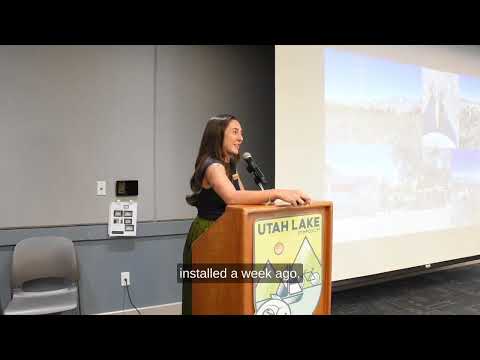
Addie Valdez, conservation education programs manager for the Utah Lake Authority, told partners the agency has reduced Phragmites australis from roughly 10,000 acres in 2012 to about 1,500 acres this year and is now focusing on native-plant restoration, partnerships and funding to sustain gains.
Addie Valdez, conservation education programs manager for the Utah Lake Authority, said the agency and its partners have sharply reduced the spread of the invasive common reed Phragmites australis and are now shifting attention to restoring native wetland vegetation and long-term watershed coordination.
Valdez said the reed once covered almost 10,000 acres of Utah Lake shoreline in 2012 and that the Authority’s combined efforts have produced an estimated roughly 80% reduction, with about 1,500 acres remaining under treatment this year. "We started about 10,000 acres ... and we're now, I think, with our rough estimations, about 1,500 acres as of this year in our treatment," she said.
The reduction followed a decade of coordinated tactics and equipment upgrades, Valdez said, including the use of Marshmaster floating work platforms to access muddy, shallow lakebed areas that were previously difficult to treat. "Marshmaster's our noble steed," she said, describing the aluminum floating machines that allow crews to reach more places on the lake.
Valdez described the project’s integrated pest-management approach, saying the Authority does not rely solely on herbicide but also experiments with grazing, inundation and other research-backed methods. The goal, she said, is to avoid dependence on any single treatment.
With invasive stands reduced, the Authority is emphasizing active and passive restoration. "Active just means that we are literally going out there digging holes, putting plants in the ground, and passive is more that we're taking a hands-off approach," Valdez said. She reported planting figures for recent work: she said "almost 85 or 86,500" plants have been installed since 2023 (transcript phrasing unclear), and specified that crews planted 40,000 this summer and about 21,000 in the last few weeks.
Valdez credited partners and labor sources for much of the progress, naming the Utah Conservation Corps, volunteer events and multiple institutional partners, including Utah State University, UVU, the Watershed Restoration Initiative of Utah, the Division of Forestry, Fire and State Lands and Utah County. She also said the Authority was "working through" $1,500,000 in current funds and hopes for additional federal funding if a budget passes.
Valdez highlighted ecological and public-safety harms caused by dense phragmites stands, saying the species alters hydrology and sediment transport, increases stagnant water and mosquito habitat, reduces native bird habitat and can create significant fire risk when it dries. She noted practical challenges in restoration work, including grazing cattle on newly planted sites, muddy working conditions, logistics for equipment and the need to coordinate work across more than 400 landowners around the lake.
The presentation closed with examples of sites where native communities are returning — she pointed to a SODMAP installation in American Fork and other meadow communities — and an appeal for continued partner coordination across the watershed, including connections to the Great Salt Lake, Jordan River and Bear Lake. Valdez concluded by thanking partners and handing the meeting to Emily Santos.
The Utah Lake Authority presentation did not record formal votes or motions; it focused on progress, remaining work and the need to secure and deploy funding for restoration and long-term management.