Get Full Government Meeting Transcripts, Videos, & Alerts Forever!
Get email alerts on the Land Use Rezoning topic
No spam. Unsubscribe anytime.
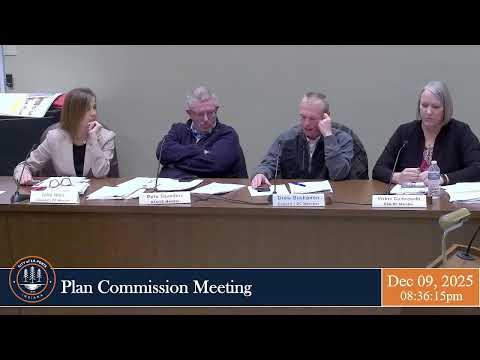
Plan commission backs rezoning to allow Lennar to convert BriarLeaf golf course into 296-home subdivision
Summary
The La Porte Plan Commission voted to recommend that the City Council rezone the permanently closed BriarLeaf Golf Course from R‑1B to R‑1D to allow a Lennar Homes subdivision of roughly 296 homes; residents raised concerns about traffic, buffers, wetlands and utility capacity, while staff described water, sewer and stormwater upgrades underway.
The La Porte Plan Commission voted unanimously on a favorable recommendation to the City Council for a rezoning that would let Lennar Homes convert the permanently closed BriarLeaf Golf Course into a subdivision of about 296 homes.
Attorney Bill Nelson and members of the Lennar team presented the petition as a response to long‑standing market and fiscal pressures. “Communities must grow or fail,” Bert Cook, executive director of the La Porte Economic Advancement Partnership, told the commission, summarizing housing studies that he said show a significant shortfall in the city’s housing stock. Nelson confirmed required notices and affidavits had been filed, and that IDEM had already identified existing wetlands on the site.
Todd Cleven, Lennar’s vice president of land, described two product lines: a core detached “townhome” product and larger “horizon” homes. Cleven said the plan would preserve over 40% of the site as open space, include walking paths, parks and four new retention basins, and is proposed at roughly 2.25 units per acre. He corrected the unit count presented earlier, saying the plan proposes 296 homes, and provided Lennar’s pricing range for the product lines.
“Those homes are designed to meet a variety of buyer segments in the La Porte housing market,” Cleven said, and he estimated the project would yield aggregate assessed value of roughly $118,000,000 and generate an estimated $1,500,000 per year in tax revenue (figures provided by the applicant during the presentation).
Residents who spoke during the public hearing raised multiple concerns. Corinne Goodson, a nearby homeowner, said she was not notified (because her lot is not contiguous) and worried mature trees would be removed: “My concern is that these trees are gonna go away.” Tim Konowitz, another adjacent resident, urged adoption of the city’s Buffer Zone A and asked that mature trees and a 50‑foot vegetated berm be preserved to protect privacy, noise and construction impacts.
Other commenters questioned traffic and safety on State Road 39, stormwater and drainage patterns into existing easements, possible impacts to adjacent property values, and whether local or union contractors would be used. Attorney Dave Ambers, representing a nearby owner, argued the requested R‑1D zoning is inconsistent with the comprehensive plan and said existing sewer and water capacity remain unresolved.
City staff and technical leads responded during and after public comment. David (staff planner) told the commission that the rezoning request is consistent with the La Porte County Land Development Plan and recommended approval. Tim Werner of the city water department outlined planned upgrades for the 39 North district — two large water towers, a new booster station and a 16‑inch feed line — and said the projects are engineered and funded through the State Revolving Fund to increase flow and fire‑protection capacity. Devin Hunsberger, the city’s stormwater coordinator, said engineers must follow the stormwater ordinance and submit a Stormwater Pollution Prevention Plan; he also said the applicant must account for off‑site runoff that drains onto the parcel.
Applicant representatives said they are coordinating with IDEM and INDOT on wetlands and traffic, will preserve deed‑restricted wetlands and design retention basins and overflow routes per state and local rules, and corrected an application inconsistency about the smallest model (the smallest model shown in the architectural imagery is 1,137 sq. ft.). Cleven also said Lennar will offer internal financing incentives and that the developer typically plates subdivisions in full and posts bonds to assure completion and municipal protection.
After commission discussion about housing need, utilities and standards, an unidentified commissioner moved to recommend a favorable rezoning to the City Council; the motion was seconded and the commission voted in favor. Commissioners recorded as voting yes in the hearing record were Vicki Gusharski, Drew Buchanan, Pete Saunders, Miles Feniger, Julie West and Jerry Jackson.
The Plan Commission recommendation is advisory; the rezoning ordinance will next be considered by the La Porte Common Council. Staff said further engineering-level reviews — traffic counts, utility tie‑ins, stormwater calculations and any necessary variances or plat approvals — would follow during the primary plan and permitting phases.