
Bannock County commissioners approve tax cancellations, adopt several city area-of-impact ordinances and sign contractor agreements
Get AI-powered insights, summaries, and transcripts
Subscribe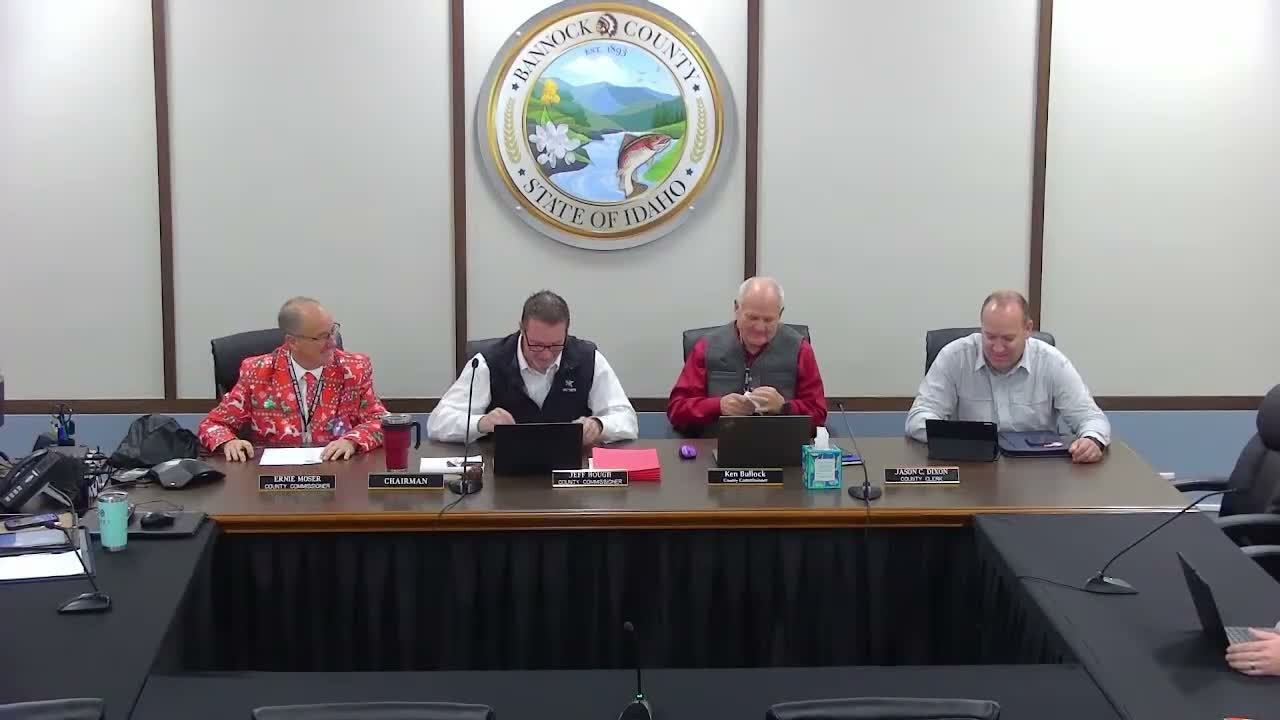
Summary
At its Dec. 16 meeting the Bannock County Board of Commissioners approved a resolution canceling specified taxes, adopted a package of county ordinances formalizing city area-of-impact agreements and signed multiple independent-contractor agreements, including a renewal tied to juvenile services.
Bannock County commissioners on Dec. 16 voted to approve a series of routine and substantive items, including tax cancellations, a package of county ordinances establishing city areas of impact, and several contractor agreements.
Chief deputy assessor Randy Hobson presented tax-cancellation requests on behalf of the assessor’s office; a commissioner moved to approve the cancellations and the board voted in favor. The action was recorded as Resolution 2025-88 approving the assessor’s requested cancellations.
The board also considered and passed a set of county ordinances identified in meeting materials as 2025-07 through 2025-13, each described by staff as an area-of-impact agreement for nearby cities. Commissioners said the ordinances followed months of staff work and public meetings before a motion to adopt carried by voice vote. The transcript lists the affected municipalities as Armo, Chubbock, Downey, Inkem, Lava Hot Springs, McCammon and Pocatello; the county clerk’s files should be consulted for official ordinance texts and verified city name spellings.
Separately, the sheriff’s office presented an independent-contractor agreement for professional services described in the agenda as a SAS services/Sharp Performance agreement. A commissioner moved to sign the contract and the motion passed.
The board approved a staff memo authorizing disposal of specified ordinance-related documents and accepted the consent agenda (certification of minutes) before adjourning to a recess for a 10 a.m. bid opening.
Votes at a glance - Resolution 2025-88 (tax cancellations): motion made and approved by voice vote; outcome: approved. - Ordinances 2025-07 through 2025-13 (area-of-impact agreements): motion made and approved by voice vote; outcome: approved. - Sheriff: independent-contractor agreement (SAS/Sharp Performance): motion made and approved by voice vote; outcome: approved. - Memo to dispose of documents: motion made and approved by voice vote; outcome: approved.
The meeting record shows voice votes of “aye” for each motion; the transcript does not record individual roll-call tallies or dissenting votes. The clerk’s certified minutes and ordinance text should be consulted for formal vote records and the official ordinance language.