
Health advisory panel: teachers report classroom access but cite material gaps and online-textbook burden
Get AI-powered insights, summaries, and transcripts
Sign Up Free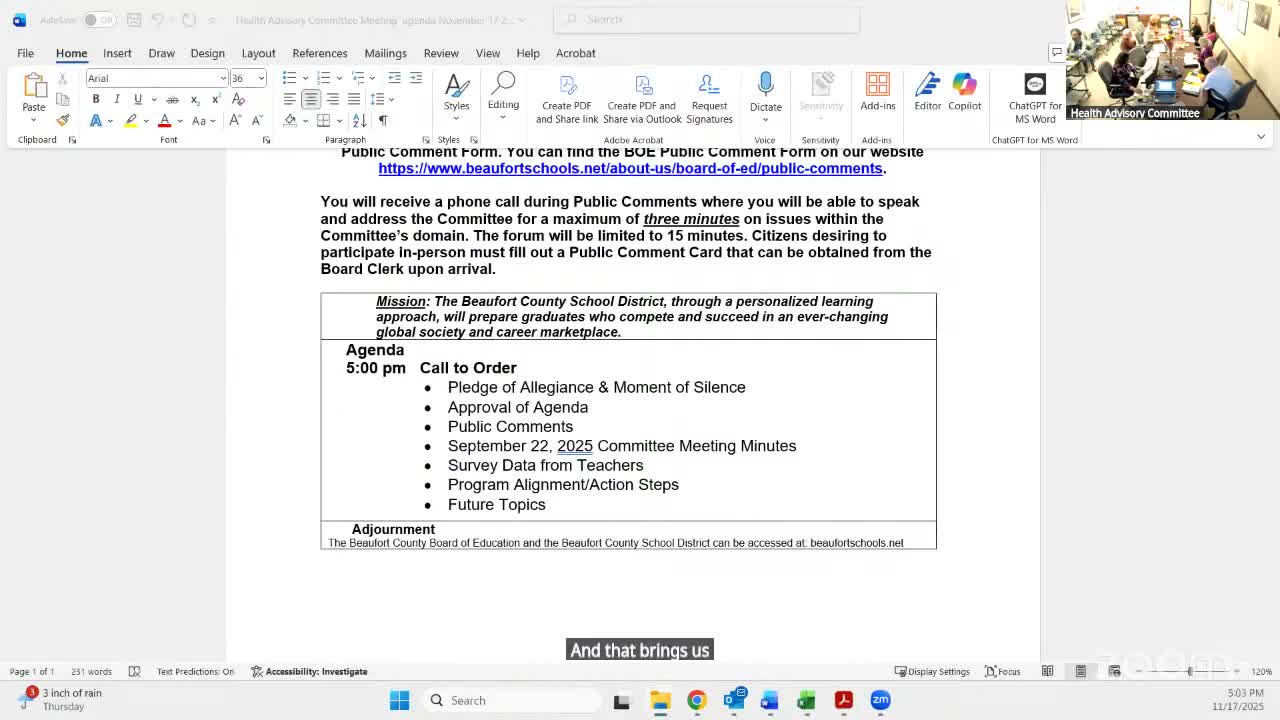
Summary
A teacher survey reported about 80% of middle-school health/PE teachers have classroom space and feel prepared, but many flagged outdated textbooks, grade-level repetition and the burden of hiding restricted online chapters—the committee agreed to pursue curriculum-writing and targeted follow-up.
The Beaufort County School District Health Advisory Committee on Nov. 17 reviewed a 14-question survey of middle-school health and PE teachers and heard that while most respondents have classrooms and feel prepared, gaps in instructional materials and online-textbook access are creating practical problems for teachers.
Speaker 2, who presented bar and pie charts assembled with Miss McKinsey, summarized the survey results: “80% of the teachers reported that they did have a place in the building to use a classroom.” She added that roughly 80% of respondents felt adequately prepared while 20% said they needed additional resources to manage student engagement and other classroom challenges.
The committee discussed a specific space problem at one school where health instruction is being taught in the gym because of limited classroom availability. Speaker 2 said district staff have met with that school and are working on solutions.
Materials were another recurring concern. Speaker 2 said about 60% of teachers judged the current materials adequate while 40% requested additional materials or resources. Committee members noted that some approved physical textbooks are used across three grade levels, producing repetition: “Not only same textbook, but it's the same page number, the same assessment, the same vocabulary,” Speaker 2 said.
Panel members also debated access to the online textbook. Speaker 2 said the HAC-approved adoption was for the physical textbook only and that the vendor initially told the district online access was “all or nothing.” The vendor later confirmed chapters can be hidden, but the workaround requires teacher-level roster changes rather than a single district-wide setting. Tech staff (Speaker 4) told the committee they can support teachers by performing checks or manual adjustments but cannot safely perform a one-time mass hide without teacher input.
Speaker 2 said the district Zoom with teachers found mixed willingness to take on the extra workload: of 21 teachers who participated, five said they would accept the additional task of hiding chapters for students; others declined, citing the time burden and risk of misconfiguration. “It’s frustrating because as a PE and health teacher, you have two curriculums, two set of state standards. You’re one person,” Speaker 2 said.
Committee members urged staff to encourage teacher participation in public comment and HAC membership so teachers’ experiences reach decision-makers. Several members recommended staff gather more detailed input from teachers about the specific questions or classroom situations that are creating uncertainty so curriculum writers can target gaps.
The committee asked staff to follow up by documenting which schools need classroom space, clarifying the exact respondent count for the survey, and identifying which ancillary materials teachers consider missing. Several members noted state-level rules do not define minutes for health instruction, which creates flexibility but also inconsistency across schools.
Next steps agreed by the committee included more targeted teacher follow-up, exploring tech-assisted solutions for online access, and accelerating curriculum-writing work (typically done in summer) to address content gaps and grade-level alignment. The committee did not take a formal vote on new policy at the meeting.