Get Full Government Meeting Transcripts, Videos, & Alerts Forever!
Get email alerts on the Zoning Code Amendments topic
No spam. Unsubscribe anytime.
Lewiston planning board reviews zoning-code edits to expand ADUs, relax some parking rules and align with state law
Summary
At its Dec. 8 meeting the Lewiston Planning Board reviewed proposed amendments to Articles 2, 5, 9, 11 and 12 of the zoning code to align definitions with recent state laws, broaden ADU eligibility, adjust parking standards and permit mobile homes where single-family housing is allowed.
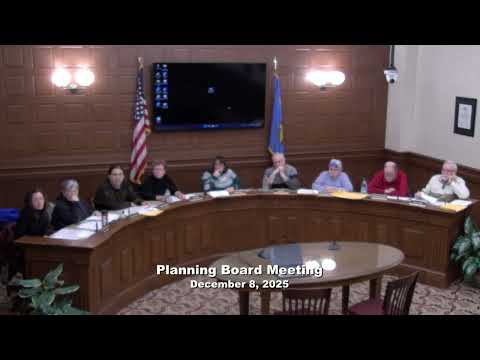
The Lewiston Planning Board on Dec. 8 reviewed a package of proposed changes to its zoning and land-use code intended to align local rules with recent state laws and to make several housekeeping and policy updates.
Staff said the initiative bundles edits to Articles 2 (definitions), 5 (administration), 9 (appeals and variances), 11 (district regulations) and 12 (performance standards). "Most of them, we have to come into compliance with in July 2026," staff said, noting some elements already took effect in September. The package includes definition updates, changes to accessory dwelling unit (ADU) rules, daycare terminology, tree-caliper measurements, mobile-home permissions, and parking standards.
Key proposed changes include: - ADUs: The draft removes a single-family limitation so accessory dwelling units may be associated with two-family and multifamily structures to comply with LD 18 29. Staff said it was necessary because the state expanded where ADUs can be located. - Daycare/childcare terms: The code's daycare terminology would be updated to match LD 2202 and related state definitions. - Setback variances: LD 1143 requires offering setback-variance applications for all dwelling units; the ordinance change extends existing variance access to multifamily buildings (the variance criteria are not changed, only the application scope). - Mobile homes: The land-use chart would permit mobile homes in all zones where single-family housing is allowed and would allow mobile homes outside mobile-home parks, reflecting prior state action. - Downtown lot size and height: The downtown-residential district's minimum lot size is proposed to drop from 4,000 square feet to 2,500 to allow a subset of small downtown lots to develop; staff described 2,500 as "a pretty standard dimension of a lot in the downtown." The proposal also adds a minimum height in the neighborhood-conservation B district to reduce the chance of undersized structures that would conflict with neighborhood character. - Parking standards: To comply with LD 427, the draft reduces some residential parking requirements and proposes simplifying commercial parking by shifting more uses to square-footage-based metrics. Staff said this would generally reduce required parking for commercial uses and that consultants reviewed examples in Auburn and Lewiston.
Board members pressed staff for clarity on how certain changes would operate in practice. Alexander Pine asked how many downtown lots could be developed under the smaller minimum; staff said it would likely enable "at least probably a handful" of properties downtown. Members also debated operational parking requirements for lodging uses: the draft lists three fixed spaces plus one per sleeping room for motels/hotels/inns, while bed-and-breakfast rules keep separate dwelling-unit standards. Several members requested consistent operational parking for B&Bs and motels and suggested possible compromises (a small reserved number of spaces for operations plus per-room spaces).
Members also questioned consolidating "neighborhood retail" into a broader retail category with a one-space-per-500-square-foot requirement. Several said that change could unintentionally increase off-street requirements for small walkable neighborhood stores; staff agreed to clarify the labeling and to consider explicitly allowing on-street parking or a 'no off-street parking required' designation in certain residential walkable districts.
The board did not take a vote; members offered typographical fixes and substantive feedback the staff will incorporate before the proposed edits return for public hearing. Planning staff asked the board to finalize feedback so the revisions can go to a public hearing at the next meeting. Member Zoe Lindstrom offered to compile minor typographical edits and forward them to staff by email.