
Planning commission backs Coastal Dunes PUD despite neighborhood warnings about dune breach and road
Get AI-powered insights, summaries, and transcripts
Subscribe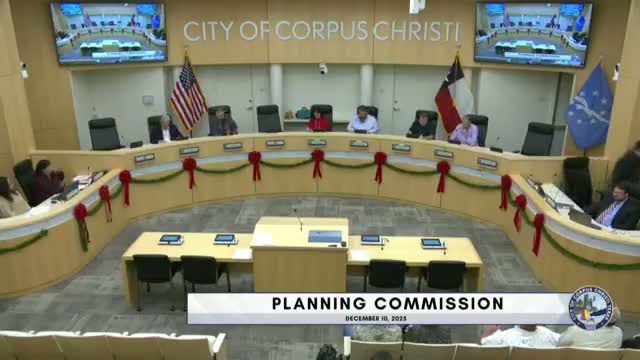
Summary
The City Planning Commission voted to recommend approval of a planned unit development (ZN8725) for Coastal Dunes LLC at 6753 State Highway 361, advancing the rezoning to City Council despite sustained public opposition centered on a vehicular beach access road, potential dune breaches and threats to wetlands and wildlife.
The City Planning Commission voted to recommend approval of zoning case ZN8725, a planned unit development (PUD) proposed by Coastal Dunes LLC for property at 6753 State Highway 361, sending the matter to City Council for final action.
Staff introduced the PUD as a mixed residential proposal that would include 99 single‑family lots and 32 townhouse lots with six common‑area amenities. Staff said the PUD includes two explicit deviations from the Unified Development Code (UDC): townhouse lots as small as 1,700 square feet and townhouse lot frontages reduced to 22 feet. Andrew Dimas (staff) told the commission the technical review committee had evaluated the plan, that the master site plan is “married” to the future plat, and that the proposal meets the UDC criteria the city uses to evaluate PUD requests. “We recommend approval of the rezoning,” staff said.
Neighbors mounted a broad, often emotional opposition during the public hearing. Melissa Heckmaster of Lost Colony Villas opened the block of speakers by saying, “We are here to voice our opposition to the current rezoning PUD being proposed,” and dozens of residents from Lost Colony Villas, Sandpiper, Seagull and other nearby communities raised consistent objections: the plan’s higher density and reduced lot widths would alter longtime neighborhood character; proposed homes sited close to existing boundaries would erode privacy; and the PUD as drawn embeds a vehicular beach access road that community members say would require cutting active dunes and increase storm‑surge and erosion risk.
Speakers cited environmental concerns and outside technical work. Casey Patterson referenced an independent assessment by SWCA that, he said, found the proposed access would “create a hole in the natural barrier, reduce erosion protection, increase storm surge risk, and negatively impact habitat for federally protected species.” Multiple speakers asked the commission to remove the beach access alignment from the roadway master plan before approving zoning.
Developer Jeff Hutsler said the developer also does not want the vehicular access road but that the road is on the city’s current roadway master plan and therefore shows on the proposed PUD map. “We don't want it,” Hutsler said, and he reported the team has obtained a jurisdictional determination for wetlands and committed to protecting more than the minimum required area. He said the site’s wetlands constrain where higher‑density lots can be moved and that the developer will pursue a separate roadway‑master‑plan amendment to remove or relocate the alignment.
Staff clarified the procedural point commissioners repeatedly raised: the roadway is on the city’s master plan today, so it remains part of the staff recommendation unless and until the roadway master plan itself is amended. Dimas said, in effect, “That roadway exists unless the developer comes back and asks again” for a master‑plan amendment; amending the master plan is a separate public process.
Commission discussion balanced competing policy goals: several commissioners said they were sensitive to dune and habitat concerns and to neighborhood impacts, while others emphasized that the site is currently zoned in a way that could allow far higher densities if the commission denied the PUD. After Commissioner debate, a motion to recommend approval of the PUD passed by voice vote; a commissioner later clarified on the record that their intended position differed from the voice response recorded at the meeting. The commission’s approval is a recommendation to City Council, and staff said the developer still must secure subsequent technical approvals, plats and any beachfront construction permits (including state or federal approvals) before building could begin.
What happens next: The Planning Commission’s recommendation will be forwarded to City Council for final action. Staff said they will continue to accept written comments and are available to meet with neighbors and the developer as the plan proceeds through the remaining regulatory steps. The roadway master plan remains a separate lever; if the access alignment is to be removed, that will require a follow‑up amendment and another public hearing.