Charles County BOE: First-quarter common-assessment data prompt targeted coaching, interventions
Summary
District leaders told the board that first-quarter common-assessment results show uneven progress — subgroup gains in some subjects but overall scores that did not improve — prompting plans for expanded coaching, more frequent progress monitoring and targeted interventions using MTSS and digital platforms.
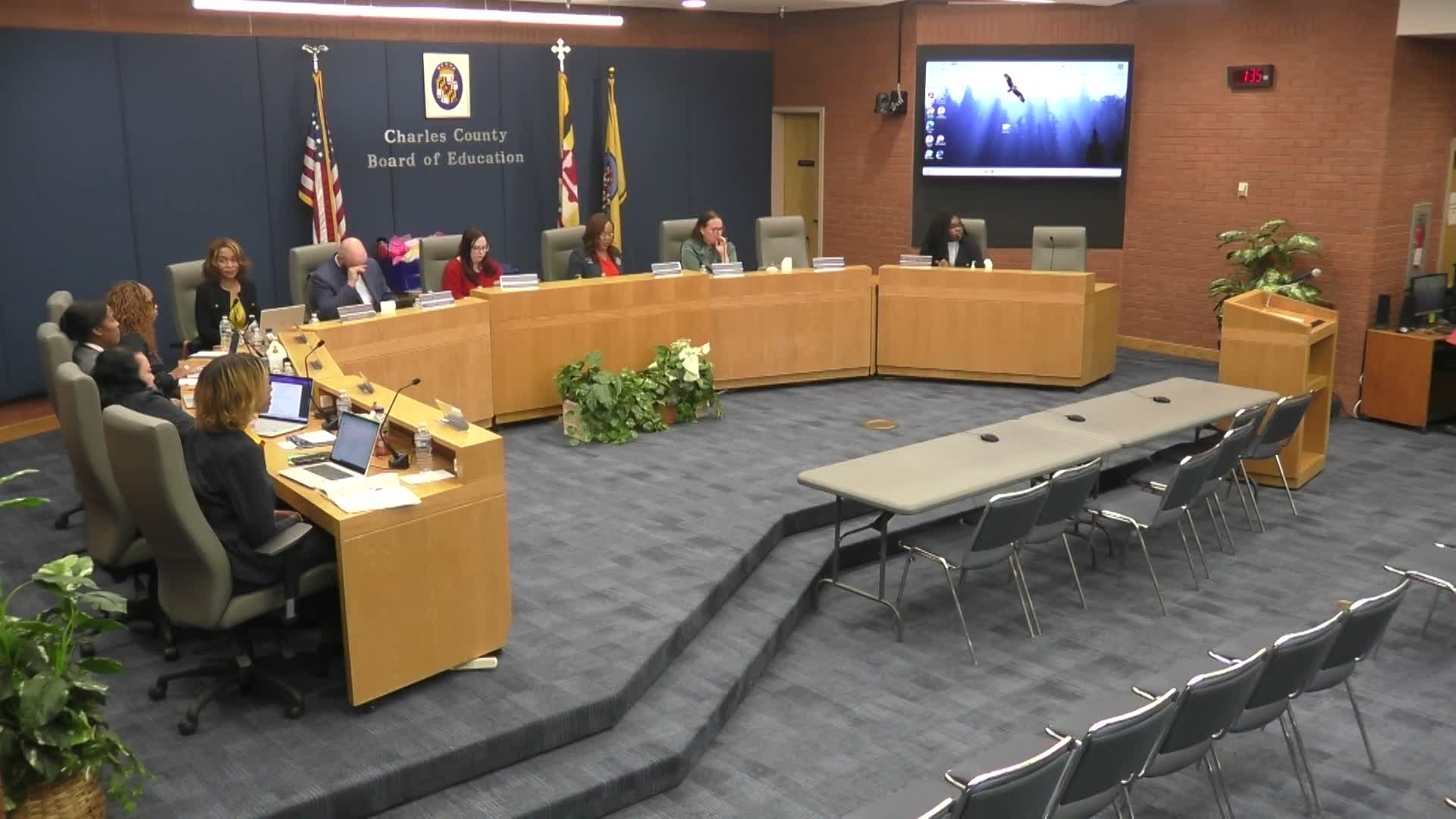
Charles County Public Schools presented first-quarter common-assessment results to the Board of Education on Dec. 9, showing mixed outcomes that district leaders said require targeted instructional responses.
Dr. McKenna Lewis, director of elementary education, told the board the assessments are meant as unit-level benchmarks and “provide instructional decision making” to guide reteaching and small-group support. She said the system has 5,512 active MTSS plans in the student information system and that roughly 2,800 of them address foundational math skills while about 2,600 focus on reading and decoding.
The presentation, which covered item-level analyses and alignment with the state test, noted improvement in science and social studies after adoption of a social-studies textbook. But district presenters said reading and math results remain below expectations and that the data show improvement within some subgroups even when overall scores did not rise. “If you do better in every subgroup, you should be feeling better overall,” a presenter said, adding staff are digging into why that apparent mismatch occurred.
Board members pressed for specifics. Vice Chair Kramer asked about Algebra I performance after slides showed many students scoring below 60 percent; staff said a common issue was students demonstrating work on paper but not entering it into the district’s digital platform, which led to zeros on items where students failed to record their thinking. Secondary staff said they are emphasizing practice in platforms that mimic state testing and using weekly progress monitoring in interventions such as math labs.
On the timing for feedback, the district said most common assessments are open for about two weeks, with an additional week allowed for teacher scoring on longer tasks. Staff described a two-week feedback window as the typical cycle that gives teachers time to reteach or spiral content while staying on pacing.
Presenters said the district is strengthening collaborative planning, coaching aligned to the Danielson framework, and selection of high-quality instructional materials. They also described work to build teacher capacity so interventions are implemented with fidelity and to ensure the data are used for whole-class reteach days or smaller-group supports as needed.
The district plans to return to the board in the spring after more common assessments are administered to report on whether trends change as additional data accumulate.