
Jones County officials, utilities outline limits of local infrastructure, $25M water expansion and how large projects pay for upgrades
Get AI-powered insights, summaries, and transcripts
Subscribe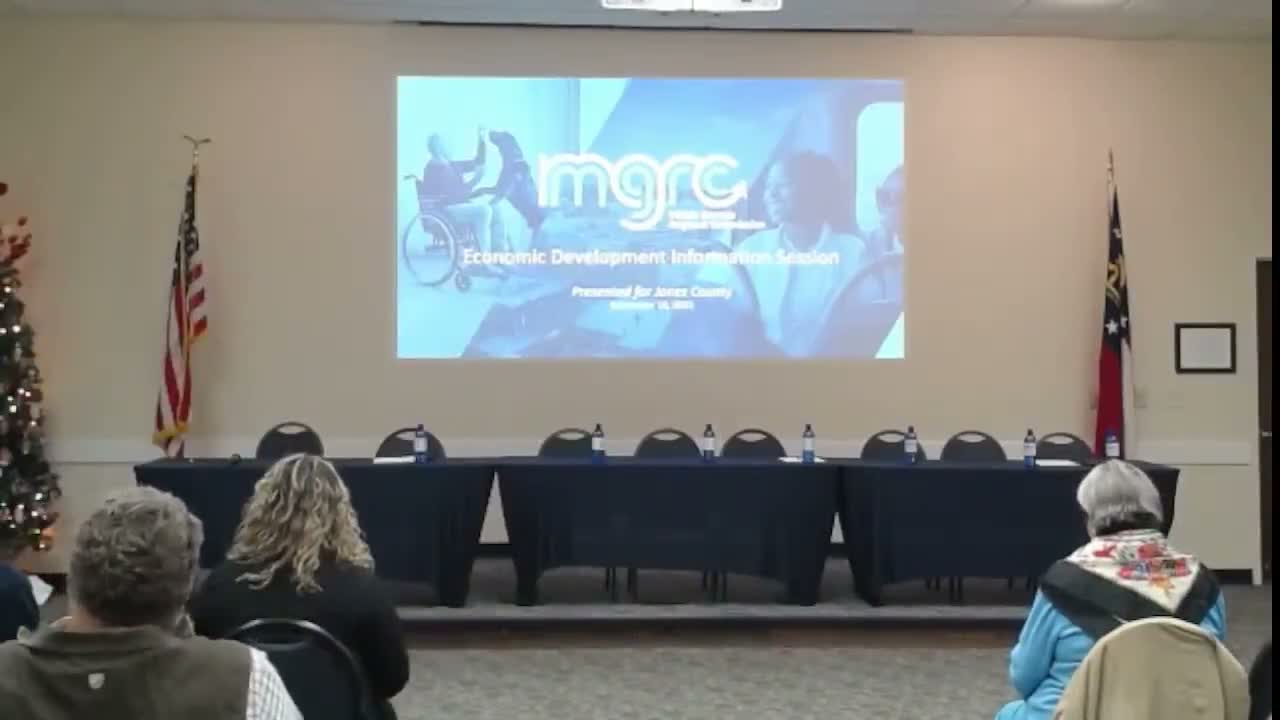
Summary
At a public session hosted by the Jones County Development Authority, regional planners and utility providers described how the county evaluates potential industry projects, explained thresholds for ‘large’ electric and water loads, and said developers or large customers generally fund needed infrastructure while the county pursues a $25 million water-system expansion.
Jones County officials and regional utility representatives on Monday described how local and state processes shape decisions about recruiting industry, who pays to extend infrastructure, and current limits on water and power capacity.
Eric Varnedoe, chairman of the Jones County Development Authority, opened the meeting and said the goal was to explain “what economic development means for Jones County, and what it means for the state of Georgia.” Greg Boiecki of the Middle Georgia Regional Commission framed economic development as a mix of recruiting new employers and supporting existing businesses. Boiecki said confidentiality is an accepted part of early-stage negotiations: “Because for a company, if news of where they want to locate leaks out ... that can be the difference of millions of dollars,” he said.
Haley Watson of the Jones County Development Authority described recent inquiries the authority has reviewed, naming industries including ammunition manufacturers, aerospace/Department of Defense contractors, tire and food production, and data centers. Watson said the authority evaluates projects by capital investment, job creation, infrastructure and housing impacts, and may reject projects that do not fit community priorities. “We’ve had projects that want 1,700,000 gallons of water per day … so when those projects come in, we as a board look at them and turn them down because they’re not a good fit for us,” she said.
On water capacity, Brandon Stark, superintendent for Jones County Water and Sewer, said the county is undertaking about a $25,000,000 expansion to address wells going dry and routine needs. He said the county’s connections to the Macon Water Authority could supply roughly 4,000,000 gallons total and that the system’s 2024 maximum day was about 2,000,000 gallons. Stark summarized the county’s approach: emergency fixes, new wells and staged expansions tied to funding and demand.
Panelists from electric providers described how large electric customers are handled differently than ordinary residential or small commercial users. Georgia Power and local cooperatives explained that customers above state thresholds for choice (examples cited: 900 kW in recruitment contexts; panelists then discussed loads of tens to hundreds of megawatts for modern data centers) are evaluated for available infrastructure, projected rates and build costs. A Georgia Power representative said planning and regulatory changes have aimed to ensure new large customers pay the costs of required upgrades rather than shifting them to residential ratepayers.
Joey Heath of Georgia Transmission Corporation said transmission planning is a coordinated, long-range process that looks 10 years ahead to ensure reliability across co-owned systems; building new substations and transmission lines can take multiple years. Tri County EMC noted supply-chain and lead-time constraints for large transmission equipment and emphasized that utilities try to avoid speculative infrastructure without a committed customer.
On costs, panelists said responsibility depends on the project. For water, County staff said developers typically build needed distribution infrastructure for new neighborhoods and industrial customers pay for the connections they require; counties may plan larger expansions expecting to recoup costs through tap fees and rates. For power, overhead residential service often requires little or no upfront fee, but large industrial or data-center customers generally fund dedicated substations, transmission taps and any necessary on-site infrastructure.
When asked about nondisclosure agreements, the Development Authority’s representative said the local practice is to work from limited, coded project information provided by prospective companies rather than signing local NDAs; state entities sometimes manage confidentiality when required. The forum closed after a brief audience Q&A and an invitation for panelists to remain to answer additional questions.