
Agoura Hills panel recommends denying general‑plan change for proposed 76‑unit senior care project after public safety and compatibility concerns
Get AI-powered insights, summaries, and transcripts
Subscribe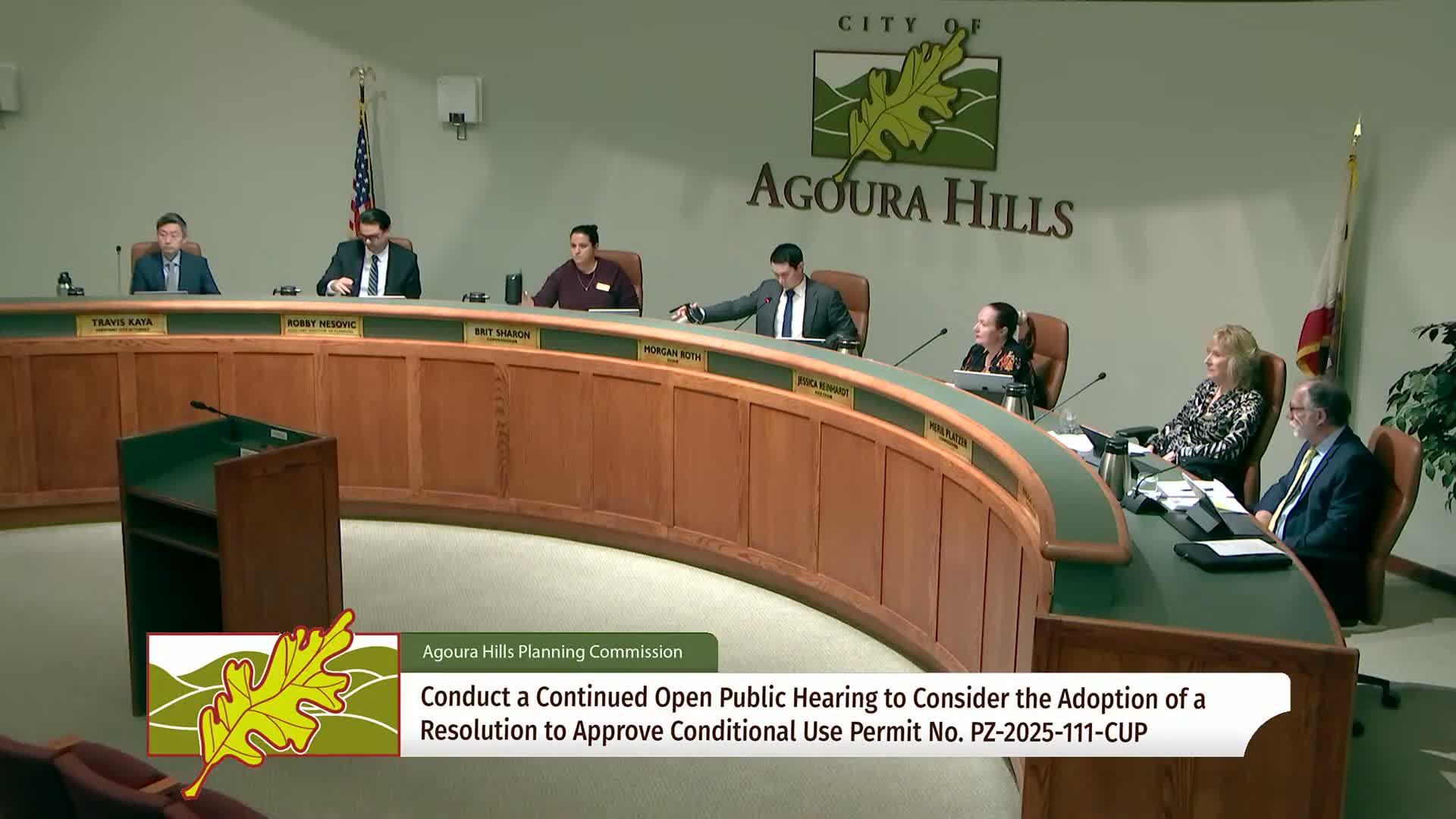
Summary
After a multi‑hour public hearing the Agoura Hills Planning Commission recommended denial (4–1) of a general plan amendment to allow a 76‑unit senior residential care facility at Agora and Chesebro Roads, citing incompatibility with the Old Agora overlay and multiple community safety and character concerns. The commission did, however, recommend adoption of the project’s Mitigated Negative Declaration (4–1) so CEQA review proceeds to council.
The Agoura Hills Planning Commission on Dec. 4 (continued hearing) recommended that the City Council deny a requested general plan amendment to reclassify a parcel at Agora Road and Chesebro Road from BPOR (Business Park Office Retail) back to CRS (Commercial Retail Service). The amendment was necessary for the applicants’ proposed senior residential care facility with 76 units (16 with kitchenettes) to proceed under the requested development plan.
What the commission did: By roll call, commissioners voted 4–1 to recommend denial of the legislative change (BPOR → CRS). Commissioner Stein was the lone vote in favor of the change. Separately, the commission voted 4–1 to recommend that the City Council adopt the project’s Initial Study/Mitigated Negative Declaration (CEQA), meaning staff’s environmental analysis and proposed mitigation monitoring program were judged adequate by a 4–1 margin; Commissioner Plattzer voted no on the CEQA motion.
Why commissioners opposed the general‑plan amendment: Commissioners who voted to deny cited several recurring concerns: - Compatibility with the Old Agora overlay and the city’s general‑plan objectives (commissioners repeatedly cited LU 12, LU 4.11 and LU 30), arguing the Old Agora overlay was intended to preserve a compact, locally serving commercial corridor rather than institutional or quasi‑residential campus uses. - Neighborhood character and scale: multiple commissioners and public commenters described the proposed massing and story‑pole visuals as large and potentially overbearing for the location. - Public‑safety and evacuation risks: neighbors and some commissioners raised wildfire evacuation and egress concerns at the nearby Chesebro/Palo Camacho freeway ramps and local streets; residents and speakers said adding a 76-resident facility plus staff and visitor vehicles could create gridlock during an emergency. - Parking and service‑level questions: staff’s code-based parking analysis required 15 stalls (1 per 5 beds); the project proposes 27 stalls — more than code minimum but residents and one commissioner said that still might be inadequate for staff shifts and visitor demand. Traffic engineering testified projected trip generation is low (approximately five AM peak trips, 14 PM peak trips) based on Institute of Transportation Engineers (ITE) rates for similar facilities; commissioners pressed whether employees’ shift patterns, deliveries and emergency trips were fully captured. - Affordability and community need: at least one physician who spoke during the hearing questioned whether market-rate memory‑care beds at this scale would be affordable or serve local low‑income seniors; staff responded that the units generally would not count toward Agoura Hills’ RHNA affordable‑housing totals.
Applicant and operator position: Owner‑developer Bryce Bridal said the project team had conducted market research and outreach, had met twice with the Old Agora Homeowners Association (which provided a 2021 letter of support) and had spoken with several operators who expressed interest. Bridal and project representatives said operator plans and state licensing would address staffing ratios, security fencing and evacuation procedures; they also said that operators routinely prepare the detailed emergency and operations plans required for state approval.
Public comment: Ten written public comments were filed and multiple residents spoke. Opponents emphasized evacuation and road‑capacity risks for neighbors living uphill, questioned outreach adequacy and urged the commission to protect Old Agora’s commercial character. A neurologist who spoke noted that memory care costs are often unaffordable for local seniors and flagged equity questions.
Next steps: The planning commission’s votes are recommendations to the City Council. Staff will draft a resolution capturing the commission’s denial recommendation for the council’s public meeting packet. The council will consider the general plan amendment and the environmental findings in a future hearing.
Key facts - Proposed facility: 76 units (16 with kitchenettes), 46,136 sq ft; roughly 40% of units anticipated as memory care per applicant discussions with operators. - Parking: Applicant proposes 27 stalls; code requirement cited by staff is 1 stall per 5 beds → 15 required. - CEQA: Staff prepared an Initial Study/Mitigated Negative Declaration; commission recommended the IS/MND for council adoption on a 4–1 vote. - Commission action on legislative item: Motion to deny the general plan amendment carried 4–1 (Commissioner Stein in minority).