
UMass evaluation finds community awareness and support for Northampton’s Division of Community Care, recommends stronger data, training and feedback
Get AI-powered insights, summaries, and transcripts
Subscribe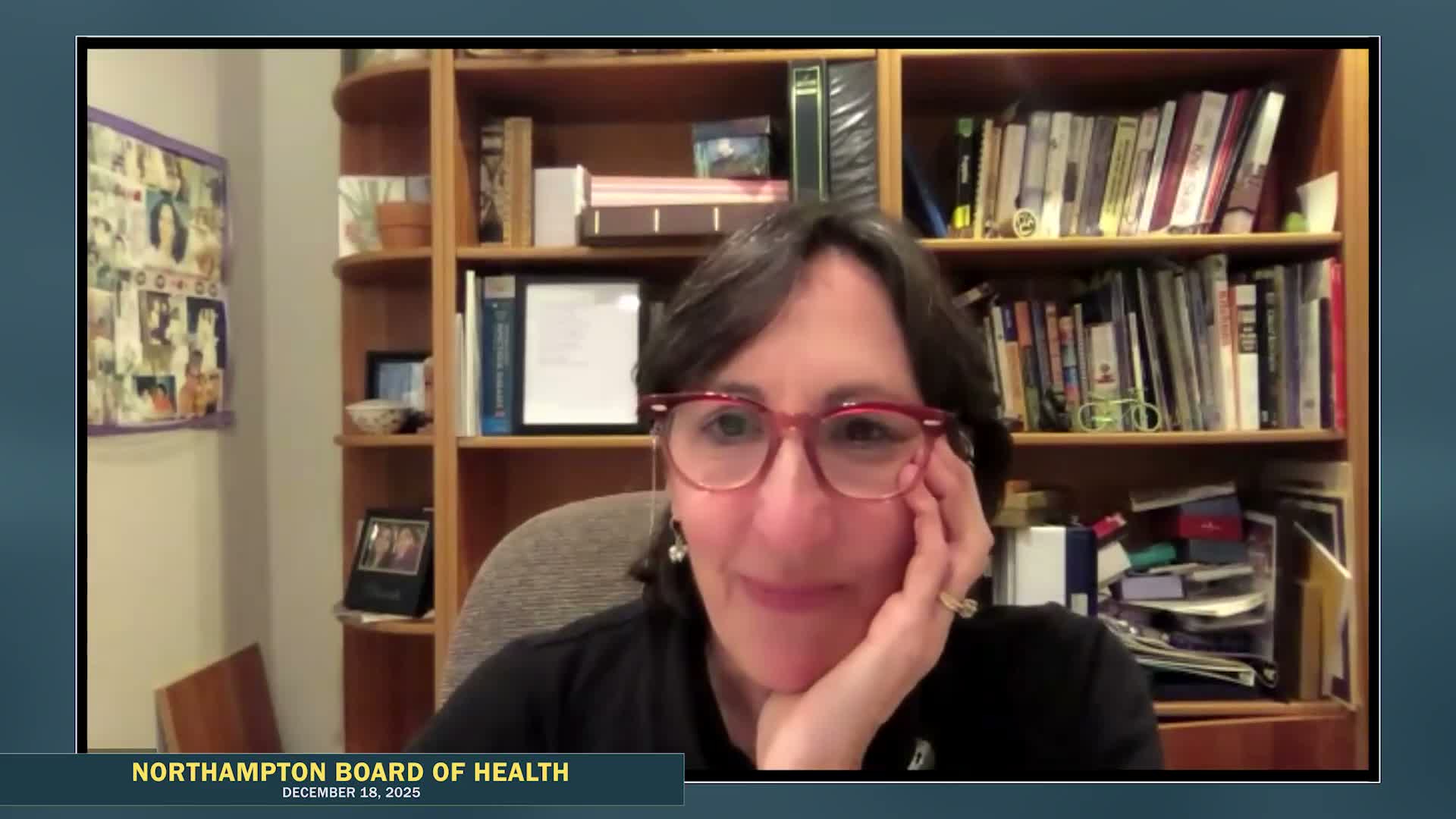
Summary
A UMass Amherst Center for Program Evaluation report presented Dec. 18 to the Northampton Board of Health finds majority baseline awareness of the Division of Community Care (DCC), community preference for community responders for nonviolent calls, and recommends improved data systems, staff training and client feedback mechanisms; UMass will present additional 9‑1‑1 analysis in part two.
Professor Jennifer Whitehill, director of the UMass Center for Program Evaluation (CPE), presented the first of a two-part evaluation of Northampton’s Division of Community Care (DCC) at the Dec. 18 Board of Health meeting, describing mixed-methods work conducted since 2023 and offering recommendations for strengthening the program.
Whitehill told board members the evaluation had three analytical lenses — formative, process and outcome evaluation — and used a mix of quantitative surveys and qualitative interviews to track the DCC’s early development, implementation and impact. “We co‑designed the evaluation with the DCC and the DHHS leadership, but we also seek to maintain our role as external evaluators,” Whitehill said.
The team conducted a 2023 baseline community survey (N=475) using online dissemination and street‑intercept methods. Whitehill said the survey found that “more than half — 56% — had heard of the DCC even before it launched,” and that 60% of respondents said they would prefer some type of community responder for nonemergency, nonviolent calls. She also emphasized respondents’ consistent caveat that “if a situation became at all dangerous, they want the police there.”
Whitehill summarized two rounds of qualitative work. Baseline partner interviews (2023) with 11 public‑safety and city officials identified potential strengths (reducing unnecessary police contact, alleviating call burden on police and EMS) and anticipated challenges (burnout and turnover among responders, integration into 9‑1‑1 workflows, accountability and funding limits). Line‑level responders interviewed in July 2024 raised similar themes: the job’s emotional intensity, value of lived experience on the team, the centrality of community trust, and the difficulty of capturing success in a single metric.
In August 2025 the evaluators conducted 19 client interviews at DCC’s drop‑in site and at Manna Community Kitchen. Whitehill said clients praised mobile outreach, administrative assistance and the program’s physical drop‑in space but that a small number of interviewees raised concerns about favoritism and about information sharing because DCC is a city agency.
Based on these findings, Whitehill recommended strengthening DCC’s data and documentation systems, continuing investment in staff training and development, and standing up client and community feedback mechanisms so problems can be reported and addressed. “We’ve collected some great baseline data, and I’m hopeful the city will be able to go back to the community and do some follow‑up to see changes now that the DCC has existed,” she said.
Board members pressed for specifics about how evaluation work would address broader community needs such as housing, addiction and behavioral‑health gaps. Dr. Cynthia Swopes asked whether the evaluation would identify service gaps as well as make recommendations; Whitehill and Michelle Ferry of the Department of Health and Human Services (DHHS) said contracted deliverables are wrapping up but that there are opportunities for follow‑up analyses, including a planned 9‑1‑1 dispatch data analysis to be presented in the second part of the evaluation.
DHHS staff described efforts to braid federal and state grants (including applications to SAMHSA and other sources) and to integrate DCC work with the DART program and police training. Michelle Ferry noted interest in economic‑impact measurements — for example, whether DCC activity reduces emergency‑department or other public‑cost burdens — as a way to quantify value for funders and policymakers.
The evaluation team made materials and slides available to the board and said it will return for the second presentation, which will include the 9‑1‑1 analysis and additional client‑record and dispatch work. Next procedural steps mentioned on Dec. 18 included standing up feedback mechanisms and continued conversations between the evaluation team, DHHS and the Board of Health.
The Board of Health meeting proceeded to routine business after the presentation and voted on minutes and adjournment. Whitehill’s slides and the UMass CPE contact information were provided to the board for follow‑up.