
School board debates revised 2025–26 budget, seeks corrective plan as unassigned fund balance falls below policy
Get AI-powered insights, summaries, and transcripts
Subscribe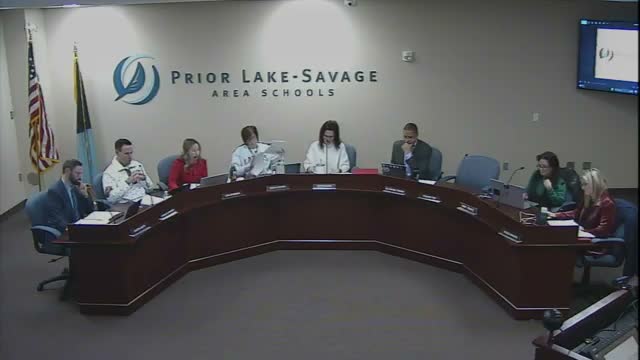
Summary
Directors pressed staff for a corrective action plan after the revised budget showed a projected unassigned fund balance near 7.3% (below the 8% policy goal). Staff presented two scenarios for handling capital transfers, a $768,423 use of fund balances, and $2.2 million in LTFM projects with roughly $503,000 on hold.
The Prior Lake‑Savage Area Schools board spent the longest portion of its Dec. 8 meeting on the district’s proposed revised 2025–26 budget, pressing staff for a corrective‑action plan after presentations showed the district’s unassigned fund balance falling below the board’s 8% policy target.
Director of business services Director Ryder presented detailed worksheets showing beginning fund balances, year‑to‑date revenues and expenditures, and two scenarios for treating an operating‑capital transfer tied to debt service. He said the revised budget currently assumes a use of $768,423 of restricted/reserved fund balances in the general fund and projected a total of roughly $13.0 million in beginning fund balances across all funds.
Key numbers and drivers: Staff showed total planned LTFM (long‑term facilities maintenance) projects of about $2.2 million; roughly $1.66 million are completed or in progress and $503,000 were put on hold after a roughly $490,000 negative adjustment to LTFM revenue from 2024 carried into pay 2026 calculations. Staff also flagged that pay 2026 and pay 2027 are peak years for debt service payments and the district levies 105% of principal and interest to cover abatements.
Operational questions from the board focused on specific cost increases: multiple loading‑dock repair estimates rose substantially once engineers added scope and civil engineering drawings; some lighting projects require full fixture replacement because replacement bulbs and retrofit kits are obsolete, driving up cost estimates. Operations staff said civil engineering is underway and that projects will be bid in January/February with construction planned for the summer.
Fund‑balance policy and corrective actions: Several board members asked staff to bring a corrective action plan before the board in January. Options discussed included being more aggressive in special education aid assumptions, tightening transportation expenditure forecasts (transportation lines rose materially in the revised budget for special‑education routes), and reallocating certain capital levy assumptions from general levy to operating capital. Director Ryder said he could model combinations of those options but cautioned that some state special‑education aid numbers are preliminary until districts complete audits and the state reruns calculations in January.
What’s next: The finance committee will review detailed options at its next meeting and staff will return in January with one or more revised budget scenarios and the requested corrective plan. Board members said they want explicit trade‑offs identified (what services would be reduced if deeper cuts are chosen) and earlier visibility on procurement/bid results for high‑cost LTFM items.
Direct quotes from the meeting: Director Ryder warned that assumptions are not final—"I hesitated to do so because I don't have final numbers from the state"—and several directors asked for a plan to bring the unassigned fund balance back into policy without surprise during the audit process.
Outcome: No budget vote was taken; staff was directed to return with options and corrective action proposals in January.