Get Full Government Meeting Transcripts, Videos, & Alerts Forever!
Get email alerts on the Land Use Subdivision topic
No spam. Unsubscribe anytime.
Monroe County planners debate 25-year reservation in sliding-scale subdivisions
Summary
The Monroe County Planning Commission reviewed a proposed text amendment to the county development ordinance that would retain explanatory language about the sliding-scale subdivision and its 25-year reservation. Commissioners were split over whether the 25-year period has a clear legislative rationale and discussed alternatives including shorter reservations, a new subdivision type, or clarified resubdivision rules.
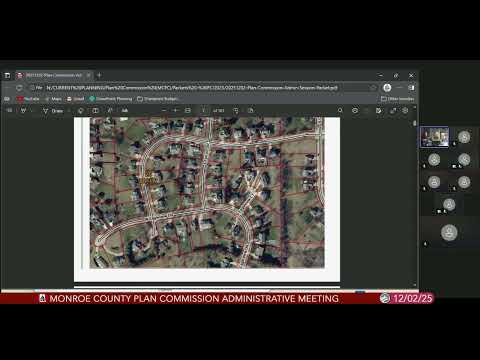
The Monroe County Planning Commission spent the bulk of its administrative meeting reviewing ZO8-25-3, a proposed text amendment to the subdivision chapter of the County Development Ordinance that clarifies the sliding-scale subdivision and the 25‑year reservation on the parent parcel.
Staff planner Jackie opened the discussion by walking commissioners through four subdivision types (administrative, minor, sliding scale, major) and the draft redlines added to the ordinance, including context about emergency response and service constraints. "So this is just a segment of the county development ordinance, the subdivision section," Jackie said, summarizing the added explanatory language and the reference to the 2015 ordinance that created the sliding scale.
Why 25 years? Several commissioners pressed that question. One commissioner noted the 2015 ordinance cited in the draft does not itself explain why a 25‑year period was chosen and asked for an empirical or legislative source for the number. The county legal adviser responded that the language is a legislative finding made by the county commissioners as part of past ordinance adoption and is intended to state the commissioners' conclusions about the reservation's necessity.
The discussion split along predictable lines. Some commissioners argued the 25‑year reservation preserves rural character, prevents serial vacating and resubdivision, and gives owners a lower‑cost option to create small, family lots without a full planning petition. Others said the period feels arbitrary without clear legislative documentation and suggested shorter terms (15 years was discussed) or creating a fifth subdivision type that permits a few more lots without triggering full major‑infrastructure requirements.
Staff clarified that the CDO already contains anti‑circumvention language: a parent parcel subject to a sliding-scale reservation cannot be partially vacated and immediately reconfigured to defeat the moratorium, and the planning department can and does advise petitioners on the calculus for lot counts and allowable amendments. Commissioners repeatedly returned to the infrastructure constraint—lots served by septic require much larger minimums than lots on public sewer—which they said is the principal limit on rural density.
Rather than finalizing a single numerical change, commissioners asked staff to capture follow‑up items: whether a subsequent sliding scale could be permitted after the reservation if sufficient acreage remains, whether a new subdivision type is warranted, and clearer cross‑references to the vacation/resubdivision section. The chair urged that those side issues be recorded as action items so the draft can move to the plan commission with a clear list of unresolved questions for further work.
The commission did not adopt the amendment at the administrative session; staff will bring clarified language and the recorded follow‑up questions to upcoming administrative and plan‑commission hearings so the group can decide whether to forward the text amendment to the county commissioners.
Ending: The commission closed discussion on ZO8-25-3 after capturing the outstanding clarifications and scheduling follow‑up; staff will adjust draft language (removing or clarifying any inappropriate references and adding explicit cross‑references to vacation/resubdivision rules) before the item proceeds to formal hearings.