Get Full Government Meeting Transcripts, Videos, & Alerts Forever!
Get email alerts on the School Facilities topic
No spam. Unsubscribe anytime.
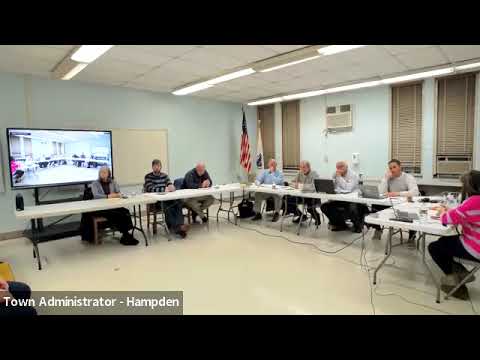
Hampden select board leans toward MSBA core application for Wilbraham Middle School, asks for 5‑year student transition plan
Summary
After extended discussion about building condition and costs, the select board signaled support for withdrawing from an accelerated-repair application and pursuing the Massachusetts School Building Authority (MSBA) core building program, contingent on a clear interim plan to protect students during a multi‑year process.
HAMPDEN — Select Board members on Dec. 2 signaled a consensus to support the school district’s plan to withdraw from an accelerated-repair application and pursue entry into the Massachusetts School Building Authority’s core building program for the Wilbraham Middle School, but they asked the district and town administration to provide a detailed five‑year plan to protect students during any multi‑year feasibility and construction process.
The board’s discussion, which included school committee members and district staff, focused on the condition of the Wilbraham Middle School building and tradeoffs between short‑term repairs and a longer‑term rebuild. Speaker 5 said the 2015 feasibility estimate for the building was about "$16,000,000 in repairs" and warned that the true cost is likely higher now.
School committee representatives explained that the MSBA accelerated‑repair program covers a limited set of envelope items (typically windows and doors) while the MSBA core building program begins with an extensive feasibility study and can lead to either a major gut rehabilitation or a new building. "The accelerated repair program can only help with the windows and doors," a school committee member said, while the core program would support a broader evaluation of educational needs and major systems.
Board members raised two recurring concerns: the practical timeline and the interim arrangements for students. Speakers cited examples from other towns, noting it can take several years from feasibility to occupancy. One administrator estimated a core feasibility process can cost several hundred thousand dollars and, depending on scope, may run into the mid‑hundreds of thousands for the study alone. Another participant estimated a full feasibility and design program for a core project could reach the $600,000–$700,000 range.
Members repeatedly emphasized the health and safety implications of leaving students in a building with aging systems. "We have issues with ventilation, CO2 levels and prior plumbing failures," a district staff member said, arguing those problems extend beyond items covered under accelerated repair funding.
Select Board members discussed interim options — including temporarily moving a grade to the high school, installing permanent modular classrooms, or performing targeted sectional repairs — and noted each carries costs and tradeoffs. One speaker warned that modular classrooms can be costly (a cited figure was roughly $250,000 per classroom in an example district) and may become a long‑term maintenance liability.
Several board members said they would be willing to provide a letter of support for an MSBA core application, subject to receiving a clear transition plan. The board asked school district and town administration to collaborate on a plan that would: identify immediate safety‑critical repairs, outline interim classroom and student‑assignment arrangements during feasibility and construction, and estimate costs and funding pathways for both the study and eventual capital work. The board agreed to place the question on a future public agenda for a formal vote.
The meeting record contains no final vote on the application; rather, members signaled a consensus to move forward with more detailed planning and to consider a formal endorsement at a subsequent meeting.
What happens next: the school district may withdraw its accelerated‑repair application and submit for MSBA invitation to the core program; the MSBA’s schedule is competitive and typically awards invitations and approvals on a multi‑year cycle. The select board asked district staff to return with a timetable and a written five‑year transition plan before the board takes a formal vote.