
City planner presents three neighborhood-based middle-school zoning options to reduce long commutes
Get AI-powered insights, summaries, and transcripts
Subscribe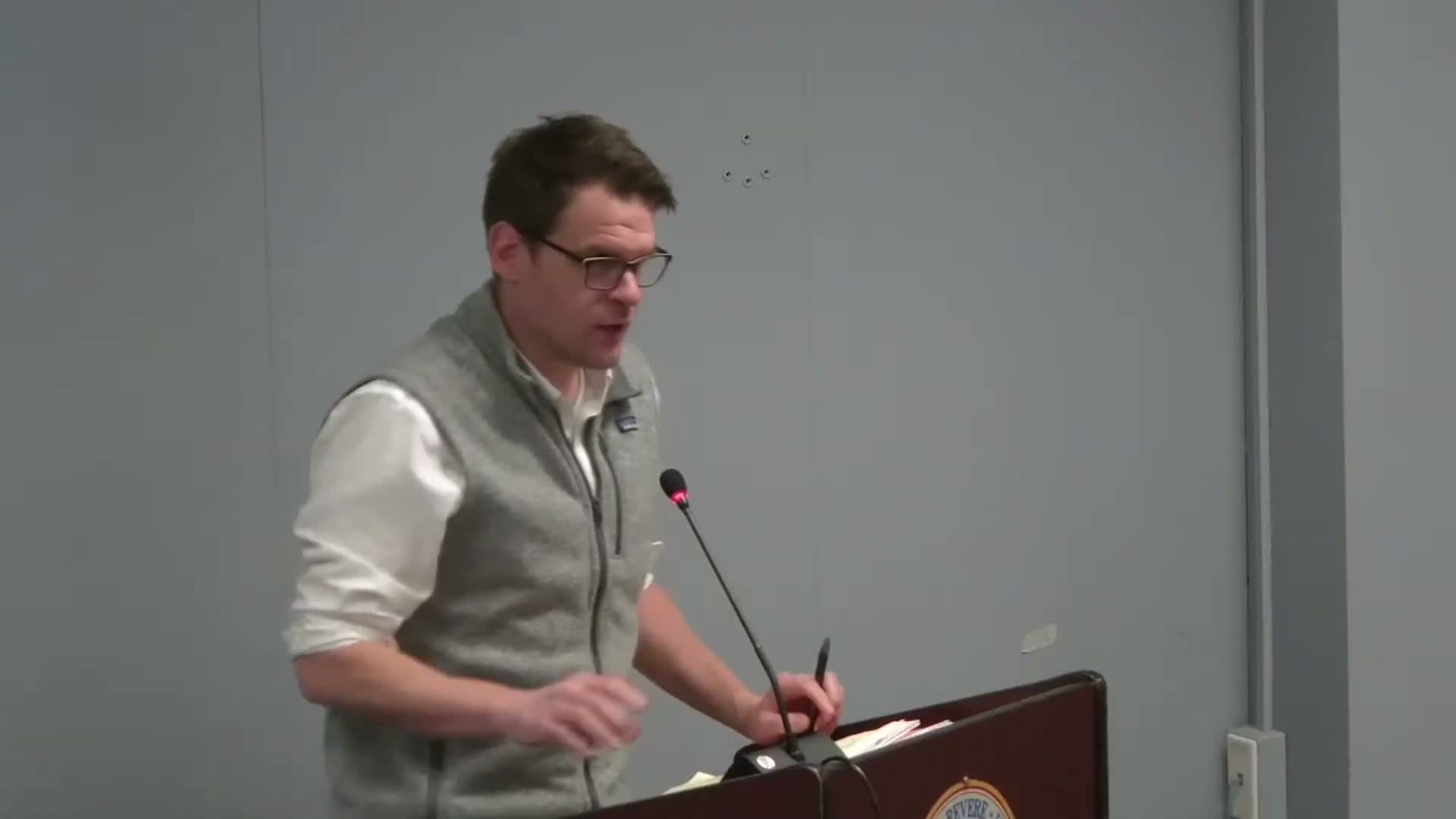
Summary
Tom Skaroska presented three preliminary, anonymized mapping options to move Revere from a lottery-based middle-school assignment to neighborhood zones; the models roughly double students living within a mile of school and reduce those living more than two miles away from 442 under the current model to under 100 in each option.
Tom Skaroska, Revere’s chief of planning and community development, told the school committee on Dec. 16 that moving from the district’s lottery-based middle-school assignment to neighborhood-based zones could substantially shorten students’ commutes.
"On average, amongst the three options we've looked at, it doubles the amount of students that are living within a mile of their school," Skaroska said, describing anonymized and slightly adjusted student-location data the district provided. He said the analyses reduced the number of middle-school students living more than two miles from school from 442 under the current lottery system to fewer than 100 in each modeled option.
Skaroska said the team worked from census blocks and adjusted boundaries to preserve natural neighborhood lines — railroads, major roads and ward boundaries — while seeking an equitable distribution of students, including English learners and students with individualized education plans. He described three options that produce marginal differences at the edges and said option 3 produced the highest share of students living within a mile of school.
Superintendent Dr. Kelly and committee members repeatedly emphasized that the maps are preliminary. "The data that you're seeing today is preliminary," Skaroska said, noting MAPC adjusted individual data points by several hundred feet to protect confidentiality. He added that the district will perform a detailed review of numbers after MAPC returns the dataset and expects to bring final options back to the committee in January for a vote.
Committee members asked about demographic balance under each option, especially the distribution of multilingual (ML/ELL) students. Skaroska gave an example breakout for one model in the current 6–8 cohort: 42% of ELL students at Garfield, 33% at RMA (Romney Marsh Academy) and 24% at Susan B. Anthony — and contrasted that with the current lottery distribution (about 33/34/32). He told the committee the models also include three-year enrollment projections informed by current elementary cohorts.
Dr. Kelly said the district plans at least one evening community meeting in early January — with translation services and both in-person and virtual access — so families can review and provide feedback before any committee vote. Committee members and staff flagged areas for further vetting, including the impact on overcrowding at Paul Revere School and whether additional options may follow.
The presentation did not propose immediate boundary changes; committee members said they expect more refined data and public engagement before deciding whether to move forward and whether to retain or end the lottery for middle-school assignments.