
Pacific Grove adopts 2023–2031 housing element, certifies EIR amid neighborhood opposition
Get AI-powered insights, summaries, and transcripts
Subscribe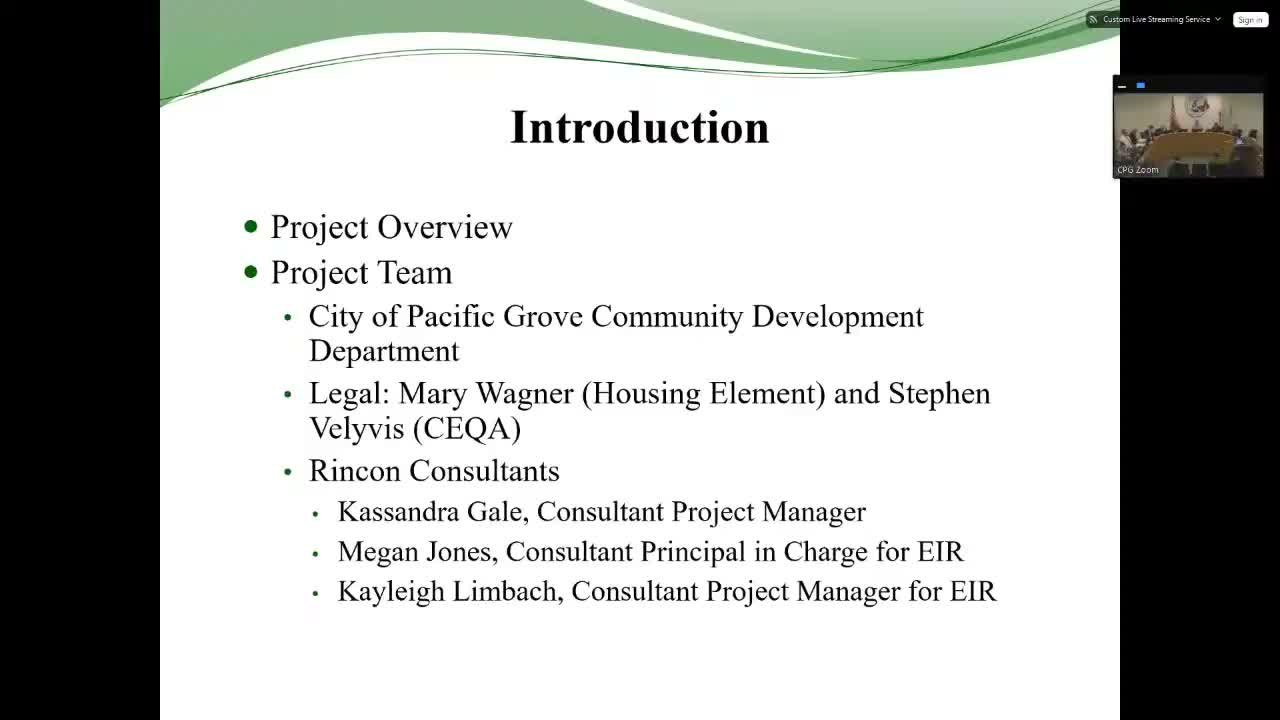
Summary
The City Council voted to certify the final environmental impact report and adopt the 2023–2031 housing element, including zoning and map amendments required for state compliance; the votes carried amid extensive public comment criticizing the choice to upzone Dennett/Synnex/Grove Acre parcels.
The Pacific Grove City Council on Dec. 17, 2025, certified a final environmental impact report and adopted the city’s 2023–2031 housing element, approving related zoning-code and land-use map amendments intended to make the element eligible for full certification by the State Department of Housing and Community Development. The council recorded the vote on the residential package as 6–0–1, with one member absent.
The action implements the city’s regional housing needs allocation of 1,125 units for the 2023–2031 planning cycle, staff and consultants said. "The regional housing needs allocation is 1,125 units," consultant Cassandra Gale told the council, and the housing element and associated rezones create a sites inventory and programs the city says are necessary to meet that state-determined obligation.
City staff and consultant Rincon Environmental presented the final EIR, which analyzed a conservative maximum-buildout scenario for the sites identified in the inventory. Rincon project manager Kaylee Limbach said "the project in and of itself does not develop housing" and that the EIR identifies some impacts that are potentially mitigable and three categories (cultural resources, greenhouse gas emissions and noise) as significant and unavoidable. Because of those unavoidable impacts, the council approved a statement of overriding considerations documenting why, on balance, the city would proceed.
John Biggs, community development director, recommended the council adopt the resolutions certifying the final EIR, approving the housing element and related general-plan and safety-element amendments, and adopt findings and a mitigation-monitoring program. Biggs noted the housing element has been reviewed by HCD and that "this is the product of many years work" by consultants and city staff.
Supporters at the meeting said adoption is needed to keep local control and avoid penalties or a state-imposed developer remedy. "Housing element compliance is critical to avoid loss of local control, loss of grant funding opportunities, and potentially also avoid incurring penalties," said Matt Huerta of the Monterey Bay Economic Partnership in public comment.
Many residents, however, urged the council to delay or change the sites selected for upzoning, focusing sustained criticism on the Dennett/Synnex/Grove Acre block (identified in the housing element as opportunity sites). Speakers raised similar concerns: inadequate notice to nearby residents, water and infrastructure capacity, emergency access and evacuation, trees and wildlife impacts, and the scale of the proposed densities. "I strongly urge the council to remove the Dennett, Sinex, Grove Acre parcel from the housing element," resident Andrew Miller said during public comment.
Public speakers also cited the EIR process and potential legal risk. A practicing county-approved field biologist noted that the California Department of Fish and Wildlife had, in his words, "notified the city on two occasions that the draft EIR need[ed] to include measures requiring that each project implemented within to be serviced by qualified biologists," and urged additional biological protections at the project level.
Council members acknowledged the community concerns but repeatedly emphasized the risk of greater loss of local control and more aggressive development under a builder’s remedy if the city is not in compliance with state requirements. Council discussion focused on balancing those risks with neighborhood impacts, outreach shortcomings and the need for project-specific mitigation and design review when properties come forward for development.
On motions before the council, members moved sequentially to: certify the final EIR, adopt the housing element and related general-plan and safety-element amendments (including CEQA findings and a statement of overriding considerations), and introduce zoning-code amendments to implement the element. The council recorded the residential-package vote as 6–0–1 (one absent). Later, the council introduced the commercial/industrial zoning amendments for first reading; the roll call for those items was recorded as five in favor, one recused/abstaining and one absent for the commercial portion (Council Member Rao recused from the second portion because of a stated conflict).
Next steps: the council will publish ordinance summaries as required and proceed with project-level review for future development proposals that rely on the adopted changes. Several speakers requested additional outreach, targeted responses to the neighborhood’s specific infrastructure questions, and that the council consider additional binding requirements (for example, inclusionary or local-labor language) in future ordinance or project-review steps.
The council recessed and then proceeded to the second portion of the housing-element update, limited to land-use and commercial-district zoning amendments; Council Member Rao recused from that segment. The meeting record shows the council passed the residential and land-use actions to align the general plan with the adopted housing element and to enable continued local review of projects that may follow.