
Expanded Schools of Hope program raises facility, cost and safety concerns for districts
Get AI-powered insights, summaries, and transcripts
Subscribe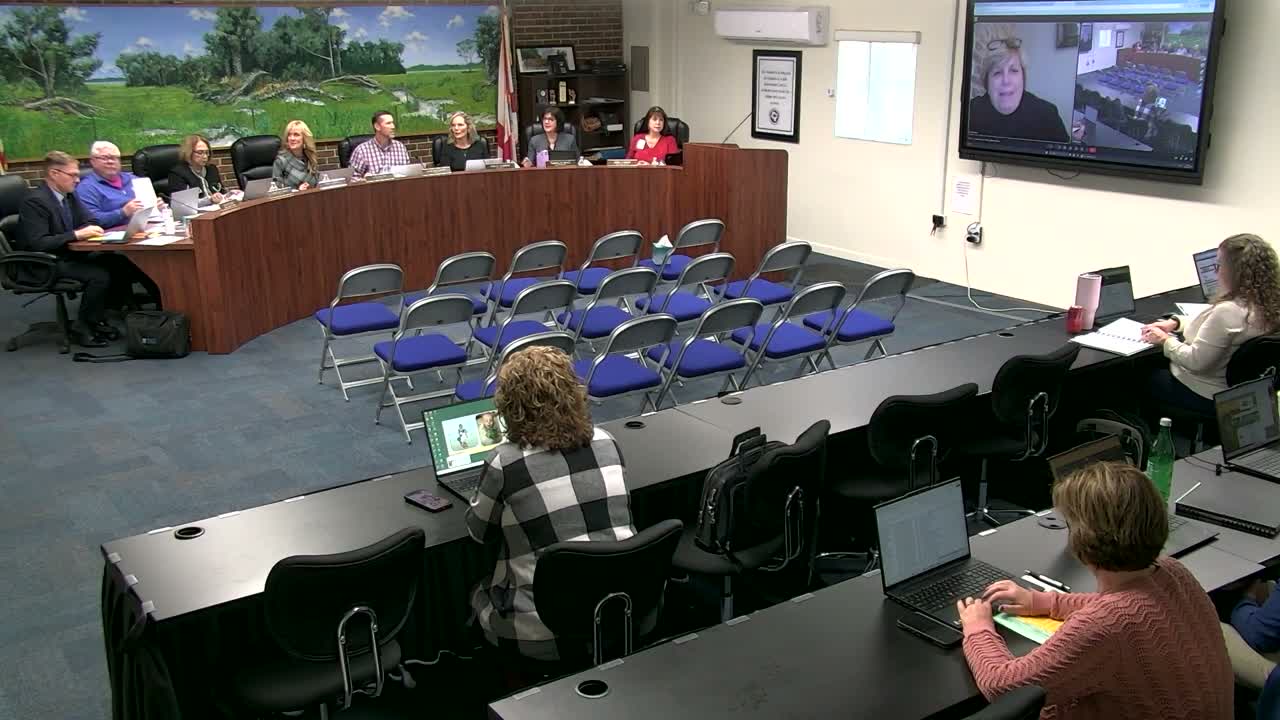
Summary
State liaison briefed the Levy County School Board on implementation problems with the newly expanded Schools of Hope program, citing inconsistent facility data, unclear definitions of "underused" space, and district costs that may approach $2,200 per colocated student.
Speaker 3, the district's state liaison, told the board that the recently expanded Schools of Hope program drew about 690 applications across 22 districts and has prompted multiple implementation questions for local districts. "There are key terms, whether it be in rule or law, such as underused, underutilized, or excess. Those aren't defined anywhere," Speaker 3 said, arguing that districts and operators need clearer definitions before placement decisions are finalized.
Why it matters: Schools of Hope allow charter operators to colocate inside publicly funded buildings. Districts rely on the Florida Inventory of Schoolhouses (FISH) to estimate available capacity, but Speaker 3 said the FISH report was not designed to capture programmatic uses—such as VPK additions, science labs, ESE rooms or tech centers—so an operator's idea of available student stations can be inaccurate. "If you have a science lab…those student station capacities because they're programmatic are captured in the FISH report," Speaker 3 said, adding that the FISH report's timing and content can leave operators with outdated counts.
District cost and safety questions figured prominently in the presentation. Speaker 3 described how many costs (food services, energy, maintenance and additional staffing) fall to the district even when an external operator uses space. She cited an example from Hillsborough County where an operator applied for 400 spaces and estimated supplemental district costs of about $2,200 per colocated student. "If you added 400 students to a school, you're gonna need another lunch lady or lunch man…you're gonna probably need another safety officer," Speaker 3 said, calling attention to unresolved questions about who covers those expenses.
Board members asked about protective measures for vulnerable campuses. Speaker 3 suggested safe‑harbor approaches for certain campuses—including schools graded A or B, schools of excellence, ESE centers or newly constructed facilities—where colocation may be impractical or harmful to program continuity. She also recommended aligning Schools of Hope application deadlines to the DOE's FISH draft/release cycle so operators see accurate facility data.
Several operational fixes remain under discussion rather than settled. Speaker 3 said stakeholders are debating whether to cap the percentage of capacity given to an operator (examples discussed: 90–95%), whether to require application fees or administrative cost recovery for districts, and whether certain programmatic spaces should be exempt from colocation. She emphasized that the legislature and rule‑making bodies are "listening" and that some issues may be addressed in rule rather than statute.
The board requested that Schools of Hope be included in the district's legislative platform as an issue for Tallahassee to address the program's "glitch issues." The liaison offered ongoing communication with district leaders to track changes in law or rule as they develop.