
Board considers bus overhaul that could push some students home after 5 p.m. to save roughly $750,000
Get AI-powered insights, summaries, and transcripts
Subscribe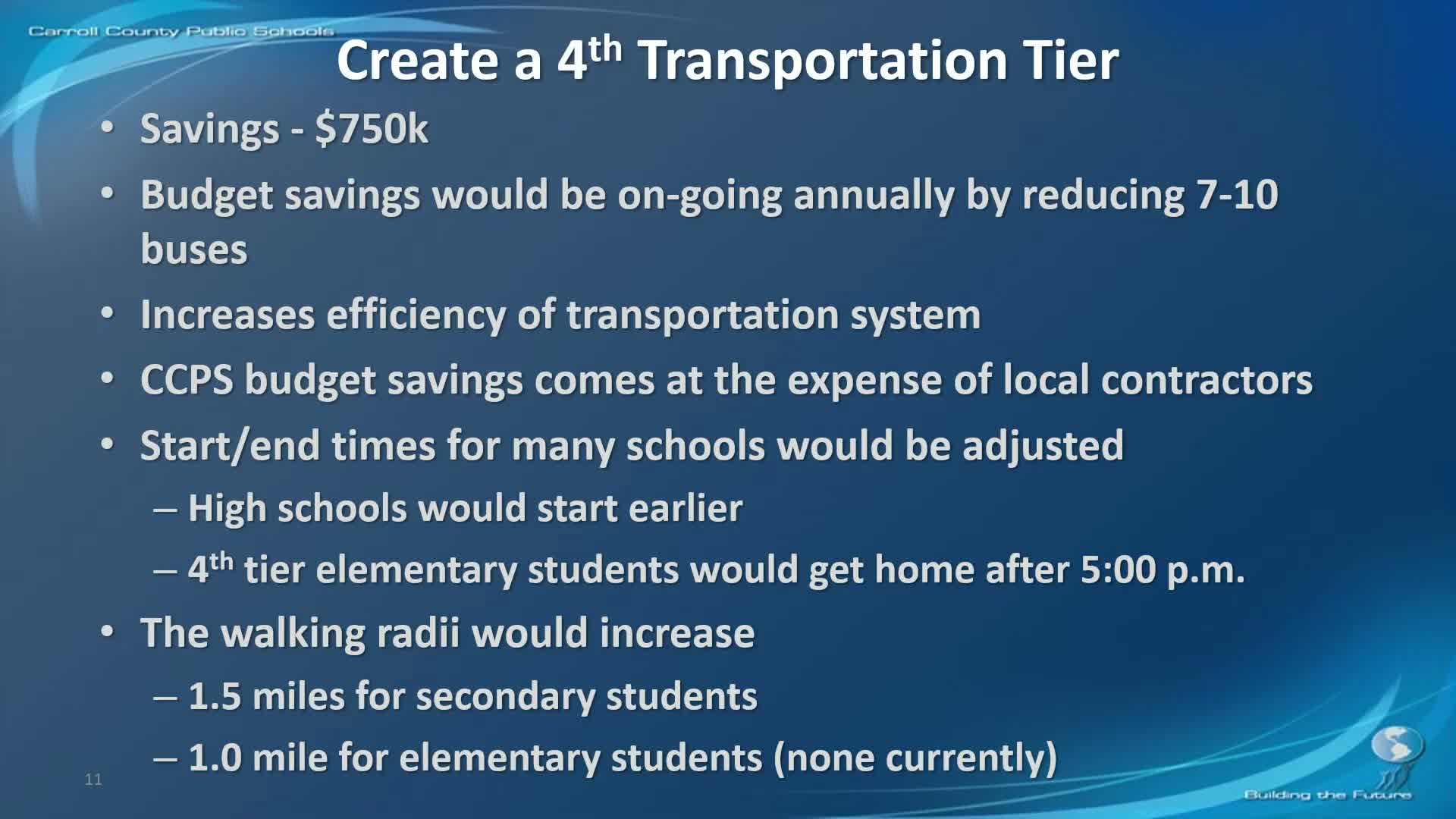
Summary
District staff told the Board that removing 7–10 buses and shifting to a fourth bus tier could save about $750,000 annually but would require major start‑time shifts, expanded walking radii and increased crossing‑guard needs; board members and parents raised safety and equity concerns and asked staff to produce prior reports for review.
Carroll County Public Schools staff presented a transportation efficiency plan on Dec. 14 that could remove 7–10 buses from the fleet and capture an estimated $750,000 in recurring savings but would require significant operational changes.
"We do estimate we could probably reduce 7 buses, maybe up to 10. And if so, it would be at least $750,000 dollars in savings," staff said, noting the reduction would be ongoing because buses would be removed from the fleet.
To realize that level of savings, staff said, the district would likely need to implement a fourth bus tier — reorganizing routes so a bus serves high school, middle school and multiple elementary runs plus a fourth run for select elementary start times. That restructuring would necessitate changing start and end times across many schools, which staff warned could make high‑school start times among the earliest in the state and lead to "students getting home after 5PM" on some runs.
Board members and parents questioned the safety and family impacts of later elementary dismissal times. Staff noted that only one crossing guard is currently provided countywide and that municipalities — not the sheriff or the board — generally supply crossing guards, which could limit the county—s ability to mitigate increased pedestrian risk. Staff also said expanding walking radii (from the current roughly one mile for secondary students to 1.5 miles and adding a walking radius for elementary students where none exists today) would likely increase parent driving and traffic congestion.
Staff agreed to locate and share prior modeling and the earlier report on start‑time change scenarios with board members during the winter break so members can review concrete school‑by‑school impacts. No decision was made; transportation was presented as part of a larger suite of options to close the FY27 budget gap.