
Carroll County schools face multimillion shortfall; board reviews cuts to outdoor school, music, athletics and devices
Get AI-powered insights, summaries, and transcripts
Subscribe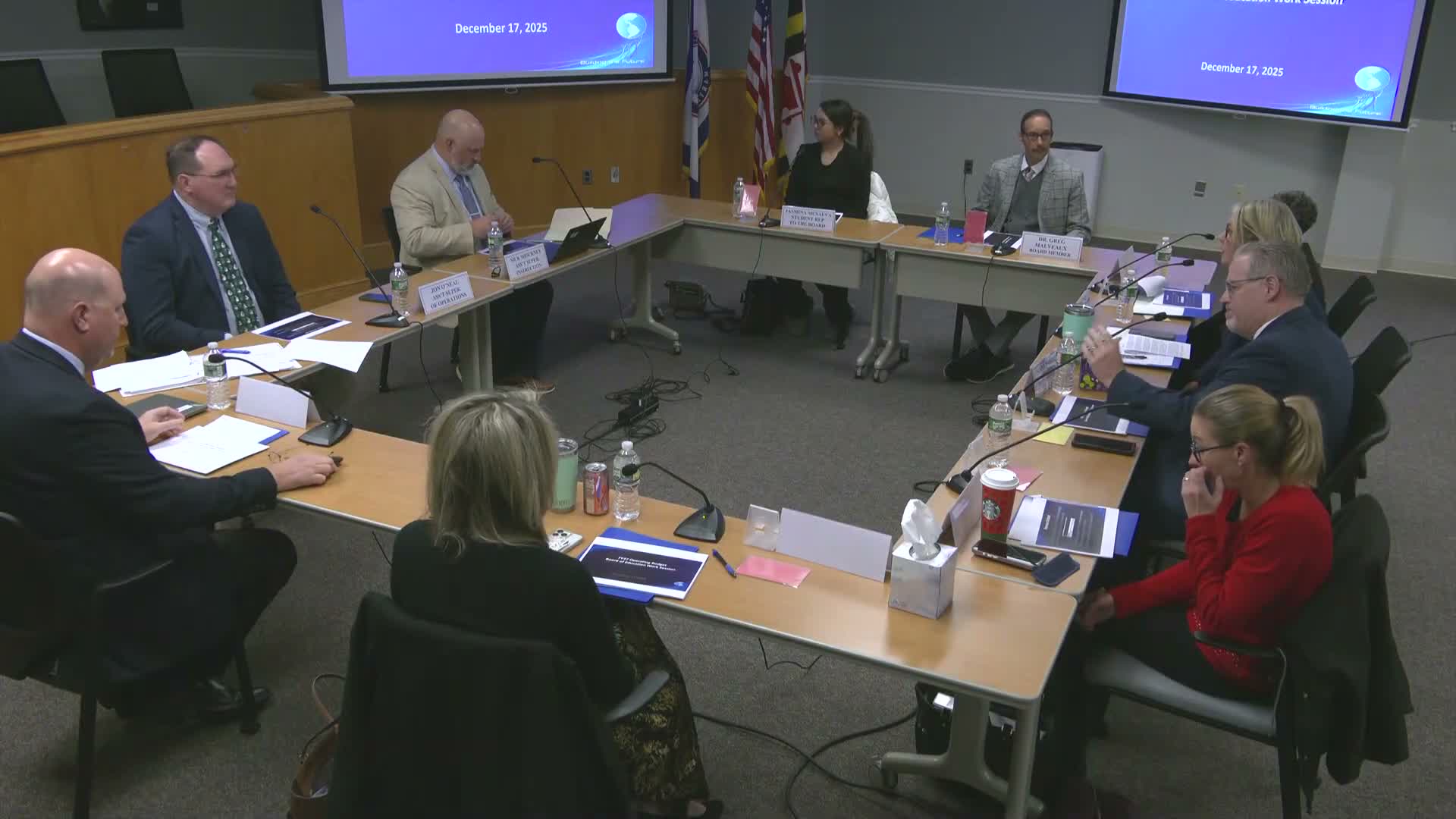
Summary
Carroll County Public Schools staff told the Board of Education that FY27 faces a likely $10–15 million operating shortfall driven mainly by employee compensation and inflation, and presented a menu of potential ongoing savings including eliminating outdoor school ($1.1M), reducing bus capacity ($750k), trimming extracurriculars ($2.6M) and cutting elementary music ($1.2M). The board asked for more granular breakdowns and another meeting after the governor—s January budget.
Carroll County Public Schools officials warned the Board of Education on Dec. 14 that the system is likely to face a multimillion‑dollar operating shortfall for fiscal year 2027, and staff presented a list of possible reductions that would affect programs from outdoor school to elementary music and athletics.
"This is our final budget session of the calendar year," Superintendent Dr. McCabe said, adding the meeting—s purpose was to "provide you with the most updated figures" and to solicit board and public feedback before the superintendent submits a proposed FY27 operating budget in January.
School finance staff told the board that combined ongoing county and state operating revenue is currently estimated at "about 14 and a half million" while identified expenditures outside yet‑to‑be‑negotiated compensation total roughly $19.5 million, producing a gap that could widen to a $10–15 million deficit depending on the outcome of collective‑bargaining talks and the governor—s budget.
"Personnel cost being the large majority of our budget when we look to enhance compensation," Mr. Burke, the staff presenter on revenues and expenditures, said. He highlighted two compensation components: roughly $2.4 million to recognize deferred step or increment costs from FY26 and an estimated $6 million to restore an annual increment, with a 1 percent cost‑of‑living adjustment estimated at $2.9 million.
To close the gap, staff presented a menu of options with estimated recurring savings: eliminating the outdoor school program (primarily savings from positions) — about $1.1 million; transportation efficiency measures including removing 7–10 buses — about $750,000; reducing technology/device replacement to move away from a 1:1 device ratio for some grades — roughly $1 million in first‑year savings but with offsetting transition costs; curtailing athletics and other extracurriculars — roughly $2.6 million (net of fee revenues estimated at about $500,000); and reducing elementary instrumental music and chorus staffing — about $1.2 million (roughly 14 FTE).
Staff emphasized trade‑offs: outdoor school uses a county‑owned facility, so cutting it reduces positions rather than property costs; converting device supports would require curriculum rewrites, professional learning and consumables that create one‑time expenses; and transportation changes would require shifting to a fourth bus tier, earlier high‑school start times and expanded walking radii with safety and municipal crossing‑guard implications.
Board members repeatedly stressed the painful nature of the proposals. "There is nowhere else to cut but what you—re presenting tonight," one board member said, after staff walked through a decade of prior reductions. Another member added that, even if the board adopted all proposed savings, an external infusion of funds would likely still be needed.
Speakers representing the community and students spoke during the session. A student who identified herself as "class of '27" said she did not personally feel shortchanged by virtual sixth‑grade outdoor programming, suggesting campus‑based biology lessons might substitute, while other citizens and board members described the outdoor school, arts and athletics as important to student development and community life.
Staff advised that the superintendent will present a proposed budget on Jan. 14 and the board must adopt its request to the county by Feb. 11 to meet county deadlines; members requested an additional meeting after the governor—s expected Jan. 21 budget to review updated state guidance and refine options.
No formal votes or motions were taken at the work session; staff said they will produce further breakdowns on athletics costs by level, provide the prior start‑time report for transportation scheduling, and compile more granular figures for follow‑up meetings.