Get Full Government Meeting Transcripts, Videos, & Alerts Forever!
Get email alerts on the Retroactivity topic
No spam. Unsubscribe anytime.
Supreme Court hears argument over retroactivity of 2011 SORA in People v. Shaver
Summary
In People v. Shaver, defense counsel urged the court to apply its Betts decision retroactively, arguing the 2011 Sex Offender Registration Act (SORA) is ex post facto punishment; the attorney general’s office countered that the address-update duty was regulatory and not subject to retroactive relief. The court submitted the case for decision.
The Supreme Court heard oral argument in People v. Shaver over whether this court’s decision in Betts — which found the 2011 Sex Offender Registration Act punitive — must be applied retroactively to convictions for failing to update an address.
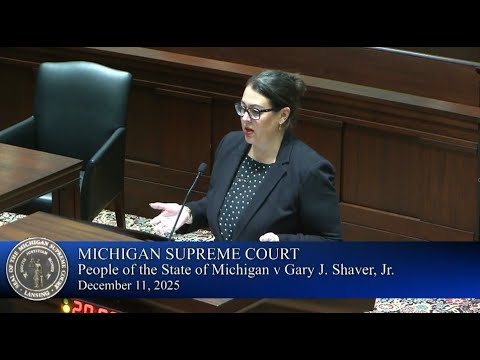
Jessica Zimbelman of the State Appellate Defender Office, representing Gary Shaver, said the court’s Betts rule is substantive and that “2011 SORRA, in its entirety, is ex post facto punishment,” arguing that Shaver cannot be prosecuted under the 2011 law for failing to update his address. Zimbelman told the court Shaver, who committed a registrable offense as a juvenile and later preregistered an address that fell through, was convicted in 2015 for failing to register and was sentenced to prison for that offense.
The attorney general’s office, represented by Eric Rastutia, urged the court not to apply Betts to cases already final on direct review. Rastutia said Shaver’s conduct — failing to update an address in 2015 — “was a crime then and it’s a crime now,” and contended the particular address-update duty at issue is a regulatory requirement that is severable from the punitive features the court identified in Betts.
Justices questioned both sides about which retroactivity framework governs collateral review and pressed whether the court should apply federal retroactivity doctrines (which focus on whether a rule renders a person actually innocent or places the law outside the state’s power to impose) or the court’s own state retroactivity tests. Counsel and the bench discussed a range of precedents the parties invoked, including Welch, Bousley, Bailey, Collins v. Youngblood and People v. Poole, with the court probing whether Shaver’s case involves a genuinely innocent person or a statutory feature the state lacked power to enact.
The bench also examined the trial record’s gaps: a justice noted the record did not clearly show whether the underlying juvenile matter was an adjudication or an adult conviction and asked counsel to reconcile inconsistent documents. Counsel placed on the record that, by stipulation in the court of appeals, the registrable offense date was 11/03/2003 and Shaver’s date of birth is 07/27/1988, making him 15 years, 4 months at the time of the offense; the distinction mattered because changes in law after 2011 altered who must register.
Both sides acknowledged practical consequences. Zimbelman said remedial routes exist (stipulated vacatur followed by collateral motions) but warned procedural complexity for defendants whose later sentences or PRVs might have been enhanced by an unconstitutional conviction. Rastutia warned that broad retroactivity could unsettle thousands of convictions and that Betts did not remove the state’s power to require an address-update duty.
After extended argument and questioning, the court announced the case submitted for decision.
The court’s forthcoming opinion will determine whether this court’s ruling in Betts is applied retroactively to Shaver and similarly situated defendants and clarify the reach of retroactivity doctrine for statutes the court has characterized as punitive.