Get Full Government Meeting Transcripts, Videos, & Alerts Forever!
Get email alerts on the Criminal Justice Retrospective Reform topic
No spam. Unsubscribe anytime.
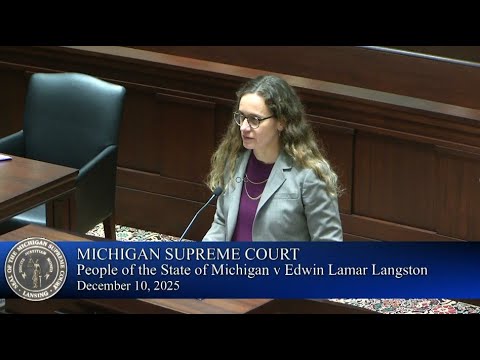
Michigan Supreme Court hears People v. Langston on Aaron retroactivity and remedies for pre-1980 felony-murder cases
Summary
At oral argument in People v. Langston, petitioners told the Michigan Supreme Court Aaron should apply retroactively to defendants whose juries were never instructed on malice; the Attorney General's Office urged prospective application and said defendants must bear the burden to show error. The Court took the case under submission.
The Michigan Supreme Court heard competing arguments in People v. Langston over whether the Court's 1980 decision in Aaron should apply retroactively to defendants tried before that opinion and, if so, what remedy should follow.
Mira Edmonds, counsel for Edwin Langston, urged the court to "vacate mister Langston's conviction and those of similarly situated defendants because the jury never found that they had the mens rea for murder," saying Aaron's one-sentence prospective statement was "wrong under the law then and even more clearly wrong under the law today." Edmonds argued that where juries were not instructed consistent with Aaron the convictions lack an essential element and that relief may include retrial or entry of a conviction on a lesser offense and resentencing.
Jessica Zimbelman of the State Appellate Defender Office, appearing as amicus for criminal defense attorneys, described the situation as "uniquely cruel" and warned that a two-step, as-applied test (first showing the jury lacked an Aaron instruction, then assessing whether the record establishes malice) raises Sixth Amendment and fundamental-fairness concerns. Zimbelman told the Court that trials "would have looked fundamentally different" had juries been instructed consistent with Aaron and urged procedures that recognize the practical difficulties of reconstructing decades-old records.
Representing the people, Eric Rastuscha of the Attorney General's Office urged the Court to treat Aaron as a substantive change in the common law that the Court properly applied prospectively. Rastuscha argued Langston's conviction was valid under the law as it existed at the time of trial and said retroactivity is barred by MCR 6.508(D) and principles of stare decisis. He proposed that, if the Court reached sentencing questions, defendants should bear the burden to show (1) their jury received a pre-Aaron instruction and (2) under Aaron the record does not clearly establish malice, a standard Rastuscha described as clear and convincing.
Justices questioned counsel about procedural vehicles and burdens of proof. Petitioners urged placing the burden on prosecutors because prosecutors are better able to locate records and because due-process principles require proof of elements by the state; the Attorney General responded that defendants must demonstrate error and that some members of the affected cohort have convictions involving particularly egregious facts that weigh against resentencing in their cases.
Counsel discussed practical issues for implementing relief: a petitioner-side proposal would require trial-court proceedings to determine whether juries had Aaron-consistent instructions and, where not, to evaluate culpability at resentencing. Zimbelman and Edmonds estimated a working count of about 93 incarcerated pre-Aaron individuals who may need case-by-case review; Rastuscha cautioned the cohort is heterogeneous and that existing record material in some cases will sustain original convictions or sentences.
Both sides identified remedies short of universal vacatur: Edmonds and Zimbelman said courts could remand for retrial or enter lesser convictions and resentence; Rastuscha highlighted resentencing to life with opportunity for parole where appropriate and emphasized reliance on the trial court's record-review functions. Zimbelman urged time-limited procedures and suggested the prosecutor could be required to initiate a record review in many cases so records are resolved in a timely manner.
The justices took the case under submission after argument. "The case will be submitted and that concludes our call for today," the court announced at the close of argument.
What happens next: the Court's decision will determine whether Aaron's rule applies retroactively to pre-1980 felony-murder convictions and whether relief follows categorically or through individualized trial-court proceedings to retrial or resentencing.