Get Full Government Meeting Transcripts, Videos, & Alerts Forever!
Get email alerts on the Water Availability topic
No spam. Unsubscribe anytime.
NRCS: Utah snowpack at roughly 70% of normal; reservoirs about 60% of capacity, Great Salt Lake ~6 feet low
Summary
Jordan Clayton of the NRCS reported statewide snow water equivalent near 70% of normal and reservoirs at about 60% of capacity, with southern basins notably below normal and streamflow approaching record minimums; NRCS expects limited short‑term improvement for northern Utah and will publish a new water‑availability report.
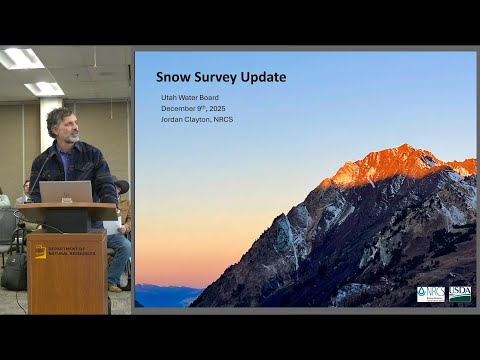
Jordan Clayton, supervisor of the Utah Snow Survey for the U.S. Natural Resources Conservation Service, told meeting attendees that statewide snow water equivalent is ‘‘about 70% of normal’’ and ‘‘about the thirteenth percentile,’’ and that reservoir storage is generally lower than a year ago.
Clayton said Utah’s snowpack peaked a little early in water year 2025, at roughly 14.3 inches statewide, followed by an early melt that produced a rapid decline compared with normal. ‘‘Wewe're about 70% of normal, which is really not where we wanna be, about the thirteenth percentile,’’ he said.
Regionally, northern Utah recorded above‑normal snow for a third consecutive winter, while southern Utah experienced a ‘‘really poor’’ season at many SNOTEL sites, several of which ended the water year in the bottom 15% of historical observations. Clayton highlighted record‑low precipitation at the Gardiner Peak SNOTEL (Pine Valley Mountains) and six other sites that recorded their second‑lowest totals on record.
On precipitation, Clayton said October boosted statewide totals and that, ‘‘as of yesterday, we're 113% of normal precipitation,’’ but he added that November was drier in many places. He said October's precipitation also improved mountain soil moisture from well below to well above normal entering winter, which should improve runoff efficiency during melt.
Reservoir storage for the 2025 calendar year, Clayton said, places the statewide percent of capacity ‘‘right about the same as we did in 2020’’ and at roughly 60% of capacity — about 13 percentage points lower than at the same date last year. An inset of basin‑level charts in Clayton’s slides showed proportionally larger drops in southern Utah basins.
Citing USGS streamflow observations, Clayton said current streamflow (not naturalized) is approaching record minimums in some basins. He also noted the Great Salt Lake level on his slide as about 4,191.5 (reported as ‘‘4191.5’’), which he described as roughly six feet below the lower bound of the group's cited ‘‘optimal range.’’
Clayton cautioned that short‑term outlooks are limited but said several forecast products, including an OpenSnow ensemble, point to a possible pattern change around Dec. 17 that would favor precipitation in Northern Utah but remain unfavorable for Southern Utah. He said a few well‑timed storms could materially improve statewide snowpack numbers, but emphasized there is still substantial uncertainty.
NRCS is preparing a new water‑availability report and updated indices that combine reservoir storage and observed streamflow to place basins into percentile categories for comparison with historical conditions. The report and indices, Clayton said, will be used to communicate basin conditions and to support water managers' planning.
Next steps: NRCS will publish the new water‑availability report and continue monitoring short‑range forecasts; Clayton invited questions and emphasized that conditions remain mixed across the state.