
City adopts updated comprehensive plan elements after debate over urban services boundary
Get AI-powered insights, summaries, and transcripts
Sign Up Free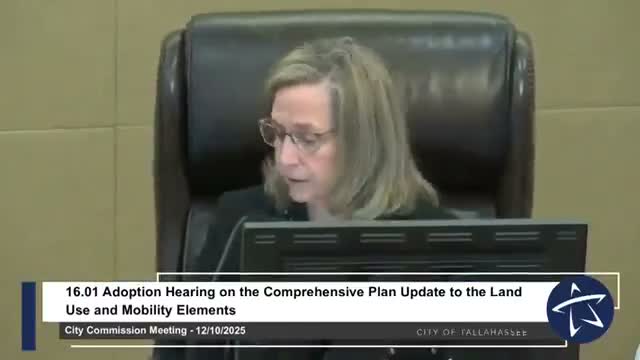
Summary
The commission adopted revisions to the Tallahassee‑Leon County comprehensive plan’s land‑use and mobility elements, aligning with county changes that removed a small set of proposed urban services expansions; the measure passed 3–2 amid calls for more transparency and neighborhood engagement.
The Tallahassee City Commission on Dec. 10 adopted amendments to the city’s 2030 comprehensive plan land‑use and mobility elements, following a county action that removed four parcels from a proposed Urban Services Area (USA) expansion. The city’s decision was to align with the county’s change and submit the joint adoption package for a 30‑day state review.
Staff described refinements made since the plan’s September transmittal, including limits on rebuilt nonconformities in residential preservation districts, clarifications on density bonuses in lake‑protection nodes, and small technical edits in response to state comments. City planners emphasized that the county’s November/December votes produced one substantive difference — removal of four Old Saint Augustine Road parcels from a proposed planned‑development expansion — and recommended the city adopt the county‑aligned map for consistency.
Public testimony focused on the process and timing; multiple speakers asked the commission not to expand the USA without a rigorous fiscal analysis of infrastructure costs, raised questions about late changes to RP‑1/residential preservation language (duplexes and cluster housing), and urged more neighborhood engagement prior to map adjustments. In discussion commissioners acknowledged the lengthy rewrite process, the tradeoffs between compact growth and infrastructure costs, and the need for further public scrutiny of stand‑alone USA changes.
The motion to adopt the staff recommendation passed 3–2. Commissioners Matlow and Porter dissented, citing concerns about process, community notice and the risk of unplanned infrastructure costs.
What happens next: The city will transmit the adopted ordinance and maps to state review agencies. If no objections are raised during the 30‑day review, the adopted amendments will take effect. Staff and commissioners said additional neighborhood‑level outreach and follow‑up items (design guidance, programmatic housing strategies) will continue in the implementation phase.