
Hamilton County School Board adopts proactive school-capacity policy after heated debate; rezoning deferred
Get AI-powered insights, summaries, and transcripts
Subscribe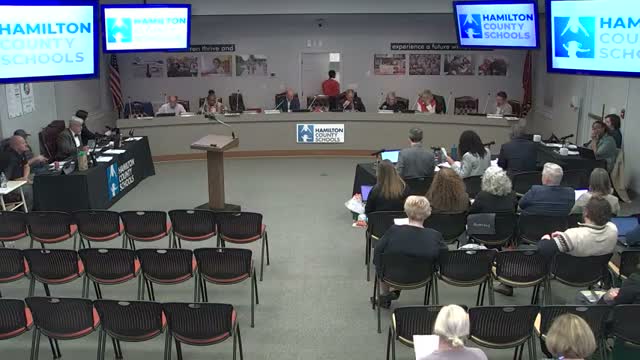
Summary
After lengthy debate over authority, public input and developer influence, the board adopted a capacity-management policy (framework) by a 7–2 vote; a joint motion to approve rezoning tied to District 2 failed earlier.
The Hamilton County School Board voted 7–2 on Monday to adopt a proactive school-capacity policy that requires an annual utilization review, tiered capacity designations and a committee process for evaluating future development and potential rezoning.
The proposal, presented by board member Mister Doherty, would flag schools at Tier 1 (95% capacity or higher) and prompt an annual review by the superintendent’s staff to identify growth pressures, inform committee discussions and consider options — including proactive rezoning of future housing lots — to avoid displacing current students or incurring costly building projects.
Much of the meeting focused on whether the board has authority to compel developers or planning agencies to consult the school board, and whether immediate rezoning should be tied to the policy. Mister Connor and others questioned accountability and legal authority, noting that the school board controls school zones but cannot force outside parties to consult it. Several board members cited historical disputes (Normal Park, Brainerd/East Ridge) as rationale for stronger, earlier involvement in development conversations.
At one point the board considered a joint motion to adopt the policy and immediately approve updated rezoning in District 2 (covering lots designated as future development). That joint motion failed after several members said rezoning should not proceed without public notice and input. The board then approved the policy-only motion, allowing staff and committees to refine the policy language, numbering and format, and to conduct community engagement before any rezoning actions.
Board chair said the policy is intended as a framework with no immediate forced actions; staff will produce annual tier maps and convene committee discussions when a school reaches a threshold. The board set follow-up steps to review the draft at committee/finance meetings in January and to collect public input prior to any final zoning changes.
What happens next: The board directed staff to bring the policy through committee review (scheduled discussions in January) and to return with format updates, state code references and proposed public-engagement steps. Rezoning of specific lots was explicitly deferred pending public input and further vetting.
Sources and attributions: The policy text and presentation were provided by Board Member Mister Doherty and district staff; debate and votes are recorded in the board transcript.