State Water Resources Control Board proposes point‑based fee system for 401 water quality certifications
Summary
The State Water Resources Control Board presented a conceptual point‑based fee methodology Dec. 8 to assign water quality certification applications to five fee tiers based on permit type, impact size, alternatives analysis and other factors; staff seek written comments by Dec. 29 and plan further stakeholder meetings in spring.
The State Water Resources Control Board on Monday presented a conceptual, point‑based fee methodology intended to reshape how fees are calculated for Clean Water Act section 401 water quality certifications for dredge and fill activities.
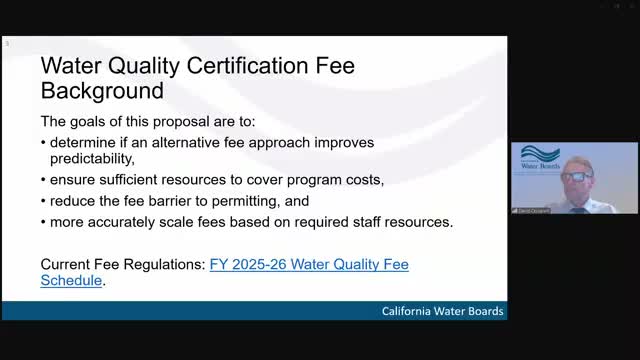
Samantha Parker, of the Board’s Wetland Permitting and Enforcement Unit, said the proposal would assign projects points across multiple factors — including permit type, permanent versus temporary aquatic impacts and the level of alternatives analysis — then bucket point totals into five fee tiers. "The goal of this alternate methodology is to improve the predictability of our program fees, ensure sufficient resources to cover program costs, reduce the fee barrier to permitting, and more accurately scale fees based on required staff resources," Parker said.
Why it matters: Board staff said the current fee structure relies primarily on impact size and has not kept pace with program workload. Parker told stakeholders the program has seen permit fee growth averaging about 12% per year in recent years and a roughly 41% increase in the last fiscal year to account for staffing and resource needs. Staff said the new methodology is intended to tie fees more closely to expected staff effort and program costs while preserving a fee cap to limit very large project charges.
How the system would work: Applications would receive points for factors such as permit type (individual 401 certification, Waste Discharge Requirement (WDR), or general order/waiver), the area of permanent and temporary aquatic impacts, and the depth of an alternatives analysis (tier 1–3). Point totals would place a project into fee tiers 1–5; staff would then weight the fee by impact acreage and apply a multiplier by tier (staff used examples such as a base rate ×1 for lower tiers and a larger multiplier for tier 5). Parker said the dollar values and multipliers are still under development and will be set after revenue forecasting.
Staff rationale and workload drivers: In response to stakeholder questions, a Board fiscal staff member said recent legal and jurisdictional changes have increased workload for some projects. Staff cited the Sackett decision and an approved budget change proposal (BCP) that added positions; one staff explanation stated processing certain WDRs now "takes about 140 hours of additional staff time per WDR," a factor that informed heavier weighting for WDRs in the point system.
Stakeholder concerns and requests: Local flood control and public‑works representatives urged the Board to avoid taxing routine maintenance and permit renewals at the same rates as new development. Andrew Ralph, environmental manager for the Santa Barbara County Flood Control District, asked the Board to create a separate fee category for ongoing public service projects and permit renewals; staff said flood control projects are outside the present scope but that a subcommittee and future analysis are planned. Arlene Chun (San Bernardino County Flood Control District) reported two recent permit coverages tied to wildfire response that each cost roughly $365,000 and offered to help with a technical subcommittee. Smaller consultants and practitioners also urged protections for homeowners and low‑impact projects, saying high fees can discourage compliance.
Data and next steps: Stakeholders asked staff to publish background distributions showing how past permits would map into the proposed tiers; staff agreed to provide permit distribution data at a future meeting. Parker invited written comments to feebranch@waterboards.ca.gov and requested input by Dec. 29 to inform the next phase of analysis; she said staff hope to bring a proposal forward for the next fee cycle and expect another Water Quality Certification stakeholder meeting in spring.
The Board’s presentation and this stakeholder meeting were framed as conceptual; no formal vote or action was taken. Staff said they will continue revenue forecasting and stakeholder outreach before proposing specific dollar amounts and a final fee schedule.