Experts debate models and data sufficiency for nitrogen-discharge accounting
Summary
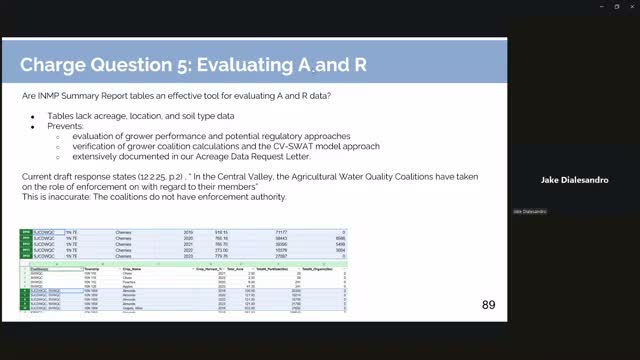
Researchers at the panel discussed tradeoffs between the simpler, transparent AmenosR metric and more complex SWAT/SWAP models, and many speakers said current reporting lacks acreage and location detail needed for precise regional accounting.
Researchers and modelers at the State Water Resources Control Board expert-panel session debated the merits of different approaches to quantify nitrogen discharges and described persistent data gaps that limit certainty.
Jake Alessandro (University of Santa Clara) and others argued that the AmenosR ("a menos r") metric used on the Central Coast is scientifically valid, straightforward for participants to apply and can yield transparent, regionally comparable discharge values. "A menos r is scientifically a valid model sufficient for regulatory purposes," one presenter said, noting that the approach can be more accessible to growers than more complex hydrogeologic models.
By contrast, speakers described SWAT/SWAP-style models as more complex and opaque to many stakeholders. Panelists cautioned that model choice affects the distribution of responsibility and the ability of smaller operators to participate.
On data sufficiency: presenters including Iris Stewart (University of Santa Clara) said current formats and reporting completeness are insufficient in many regions; she urged regular third-party audits, verification protocols and dedicated board staff to assure data quality. Panelists also noted that anonymity of data has been a policy choice and that historical court rulings and board orders have influenced what data are public.
Implications: the panel faces a trade-off between a metric that is simpler to understand and implement statewide and models that may better represent hydrologic complexity but are harder for participants and the public to audit. Many presenters urged a pragmatic approach: adopt transparent interim metrics while investing in audits, improved acreage/location reporting and technical assistance.