State water expert panel sets timeline, unveils public data tools for nitrate review
December 19, 2025 | State Water Resources Control Board, Agencies under Office of the Governor, Executive, California
This article was created by AI summarizing key points discussed. AI makes mistakes, so for full details and context, please refer to the video of the full meeting. Please report any errors so we can fix them. Report an error »
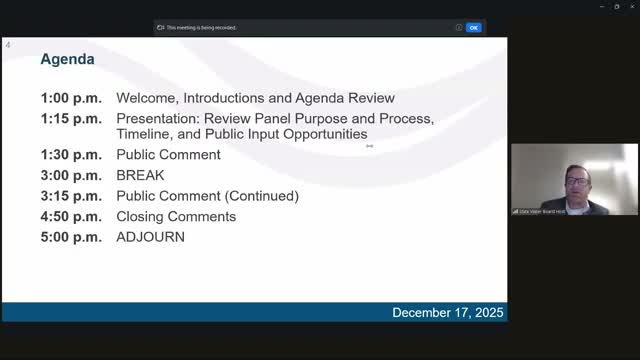
Board staff demonstrated two new public tools during the session: a Microsoft-based visualization/reporting tool intended to standardize third-party data and an interactive nitrate-risk map. "This is a visualization of a report summary...based on a platform of Microsoft," said Margaret Champine, a member of the board's staff, demonstrating filters for region, coalition and crop. Staff cautioned data coverage is currently limited to regions identified as 3, 5, 7 and 8.
The panel framed the tools as transparency measures intended to help stakeholders see regional nitrate loads and irrigated-land relationships. Lale Rastergardace, who led the map demonstration, emphasized the map is informational and not a predictive statement about potable-water quality. "This map was created in response to a request by the panel to better understand the spatial relationship between irrigated land and groundwater nitrate risk," she said.
Why it matters: state staff and expert presenters told the panel that standardized visualizations and geospatial layers will help local coalitions, growers and drinking-water managers evaluate potential discharge limits and target outreach. Staff repeatedly stressed that available data remain incomplete and that the tools are a work in progress.
Supporting details: staff said the process will include workshops and 4 working sessions in 2026, public-recorded presentations and tutorials for the new tools, and that recordings and transcripts will be posted after each meeting. The draft recommendation timeline includes a 30-day comment period after the Feb. 26 draft and an additional 30-day public comment window following a public workshop. Public comment slots during this session were scheduled for 3-minute remarks; 13 people had submitted requests in advance.
Next steps: staff will post the visualization and map publicly, solicit feedback and refine the tools ahead of the draft recommendations and the subsequent workshop series. The panel will use public input and written comments to revise recommendations for consideration at the plenary session in March or April 2026.
Don't Miss a Word: See the Full Meeting!
Go beyond summaries. Unlock every video, transcript, and key insight with a Founder Membership.
30-day money-back guarantee
Sponsors
Proudly supported by sponsors who keep California articles free in 2026

