Council adopts six‑year Transportation Improvement Plan amid Shaw Road and parking concerns
Loading...
Summary
The council adopted the city's 2026–2031 Transportation Improvement Plan, a 64‑project aspirational list that staff says averages about $17 million per year in needs against a local realistic availability of $6–9 million; residents pressed for attention to Shaw Road, bus reliability and a controversial left‑turn lane removal at a Costco intersection.
The Puyallup City Council on Dec. 9 adopted the city's 2026–2031 Transportation Improvement Plan (TIP), a six‑year, planning‑level document intended to position projects for grant funding and set priorities for corridors, intersection work and active‑transportation investments.
Transportation planner Hans Hunger told the council the TIP contains 64 projects and is aspirational rather than fiscally constrained; staff estimates an average program cost of about $17 million per year but said the city realistically expects between $6 million and $9 million locally. "That's a mix of about $1.7 million of street funds, $3 million of other local funds and $5.3 million of grants per year," Hunger said, noting projects placed on the TIP are often required for grant applications.
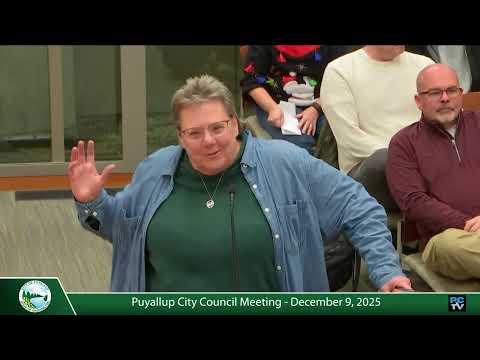
Public commenters raised several site‑specific concerns. Steve Aldridge urged clarification of item 40 — the removal of a turn lane in front of Costco — and asked whether item 52 addresses his concerns about signal timing and two‑way left‑turn lanes; Aldridge said prior staff action removed a center turn lane and the city may have legal exposure. Several residents and council members pressed for accelerated work on Shaw Road, a long‑running congestion corridor; staff said Shaw Road is a multi‑phase design effort and the city has applied for federal grants multiple times and is working on design phasing.
Council discussion emphasized the need to pursue federal grants for large projects: Councilmember Wenning noted the full Shaw Road corridor could cost about $80 million, beyond city‑only funding. Council also asked staff to show data on trip origins and whether significant traffic through the corridor comes from unincorporated Pierce County; staff said traffic‑impact studies exist and a traffic impact fee study will be presented next year.
The council moved, seconded and adopted the TIP by voice vote.
Next steps: staff will continue to refine project estimates, pursue grant sources, update traffic impact fee work and bring forward programmed projects for budgeting and design as funds are identified.