Get Full Government Meeting Transcripts, Videos, & Alerts Forever!
Get email alerts on the Zoning Variance topic
No spam. Unsubscribe anytime.
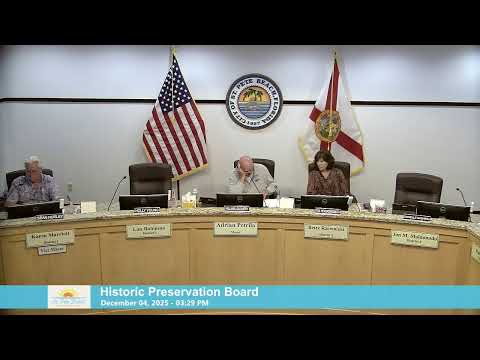
St. Pete Beach board hears contested variance request to keep front curb cut at 702 Pass‑a‑Grille Way
Summary
At an informational hearing, the Historic Preservation Board reviewed a variance request to retain a decades‑old 17‑foot curb cut at 702 Pass‑a‑Grille Way. Board members pressed staff for the rezoning history and noted the applicant must prove an undue hardship; decisions are scheduled at technical review (Jan. 7, 2026) and the Board of Adjustment (Jan. 28, 2026).
The St. Pete Beach Historic Preservation Board spent the bulk of its meeting discussing an informational variance request to retain an existing 17‑foot curb cut at 702 Pass‑a‑Grille Way, a property proposed for redevelopment.
Staff planner Brandon Berry described the request as “an unnecessary and undue hardship variance” intended to allow the front curb cut to remain after redevelopment; he noted the rear alley is platted at 10 feet and the application was deemed complete for Board of Adjustment review. Staff told the board the item will proceed to technical review on Jan. 7, 2026 and to the Board of Adjustment on Jan. 28, 2026.
Board members focused on whether the alleged hardship was self‑created by prior rezoning. Chair Lowry said the parcel had been treated differently from neighboring CRD lots and criticized what he described as a mismatch between the lot’s current zone and its alley access rules, arguing the history of rezoning needed to be documented before permitting a variance. “They want half of the ROR and half of the CRD,” the chair said, urging staff to research how the lot became part of the CRD.
The applicant, Brandon Tecklenburg, responded that he purchased the property after city staff and documents indicated it was commercial and said the existing driveway had previously been permitted and paved. “We purchased this property, I believe, for $3,900,000,” Tecklenburg said, adding that alley access is narrow (he and staff described the rear alley as about nine feet in places) and that practical constraints — including utility posts and encumbrances in the alley — make the front driveway important for access and operations.
Board members and staff reiterated the Board of Adjustment will evaluate whether the special conditions did not result from the actions of the applicant or a prior owner and that the applicant bears the burden of proof. Several members noted that, if the variance were denied, the developer could proceed with a site plan that uses alley access only or propose other parking arrangements.
The Historic Preservation Board took no formal vote at the meeting because it lacked a quorum. Staff and applicants will return materials and the zoning history for the Board of Adjustment and technical review committee meetings in January; those are the scheduled decision points.