Get Full Government Meeting Transcripts, Videos, & Alerts Forever!
Get email alerts on the Environmental Policy topic
No spam. Unsubscribe anytime.
Titusville council lets environmental commission meet twice monthly to rewrite wetland protections
Summary
Council approved a temporary expansion of Titusville Environmental Commission (TEC) meetings — two per month from January through April 2026 — after residents and TEC members urged faster revisions to comprehensive-plan language to close loopholes protecting wetlands under five acres.
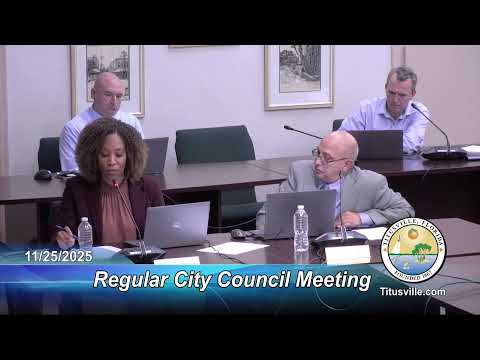
The Titusville City Council on Nov. 25 voted to allow the Titusville Environmental Commission to hold two meetings per month in January–April 2026 so the commission can accelerate work on comprehensive-plan language to better protect wetlands.
The decision follows a series of public comments from TEC members and residents who described flooding during the Oct. 26 storm and urged swift action. "The recent 15-inch rainstorm that we had on October 26 that caused so much flooding and so much heartache for our residents should drive home the importance of our wetlands," said Laurie(ie) Thompson, a TEC proponent.
Councilmember Amber Nelson moved to grant the extra meetings, arguing the commission needs focused time to finish its review. City staff reported the TEC had identified loopholes that have existed since 2010 that allow impacts to wetlands smaller than five acres. TEC members said they want four months of twice-monthly meetings (January–April 2026) specifically to revise future-land-use and conservation elements of the comp plan before the next legislative changes take effect.
Supporters including TEC chair Mary Spark Cocco and resident Michael Majek described wetlands' role in stormwater storage and in protecting potable water supply. Staff cautioned that additional meetings were not budgeted; speakers offered to defray staff time. Councilmembers debated whether to schedule extra meetings now or wait to see what state legislation will allow, but voted to approve the requested schedule.
The council’s motion passed with an affirmative voice vote. Staff and TEC will proceed with the scheduling and return to council with any required administrative details.
Council members said the effort aims to create clearer, implementable language so staff and TEC can provide timely recommended amendments to protect small wetlands, improve stormwater resilience and reduce future flooding risk.
What happens next: TEC will meet twice monthly during January–April 2026 to prepare recommended comp-plan language changes; staff will advise on any costs or notice requirements and bring proposed ordinance language back to council for consideration.