Get Full Government Meeting Transcripts, Videos, & Alerts Forever!
Get email alerts on the Education Accreditation topic
No spam. Unsubscribe anytime.
Volusia County Schools begins Cognia reaccreditation; board raises questions about remote reviews and cost
Summary
Volusia County Schools launched its Cognia reaccreditation process on Dec. 3, reviewing a six-year cycle and 31 performance standards. Board members pressed Cognia staff on a shift to remote evaluations, evaluator qualifications, Assurance #8 changes and the district’s roughly $98,000 budget for the review.
Volusia County Schools on Tuesday, Dec. 3 opened a board workshop to begin its reaccreditation with Cognia, a national nonprofit accreditation organization, with Superintendent Carmen Balgobin saying, “Volusia County has begun the process of reaccreditation.”
The district and Cognia staff outlined a six-year accreditation cycle, 31 performance standards organized under four key characteristics — culture of learning, leadership for learning, engagement of learning and growth and learning — and a timeline that includes a district portfolio submission about four weeks before the formal engagement review and a 45-minute leadership presentation as the final scheduled event. Dr. Jessica Swearer of Cognia described accreditation as “ongoing, continuous improvement and support and progress monitoring as well.”
Why it matters: District accreditation affects how the school system documents quality and continuous improvement and can influence students’ access to certain scholarship programs and postsecondary articulation. Board members said the process also has operational implications: Cognia’s revised approach moves much of the portfolio work to the district level to protect instructional minutes at individual schools, but schools will still provide artifacts and evidence.
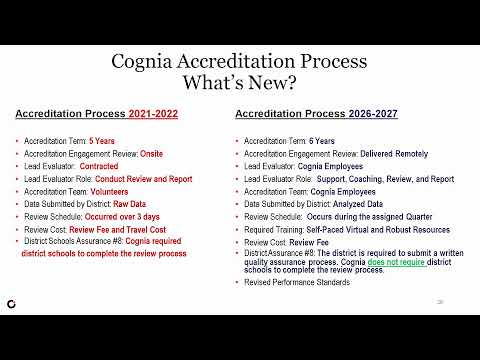
What was presented: Cognia staff said the organization extended its accreditation cycle from five to six years and added a mid-cycle progress report in year four. Jennifer Jackson, a data analyst on Volusia’s REA (Research, Evaluation & Accountability) team, said the district will compile a single district-level portfolio with campus representatives collecting artifacts so schools are not each required to complete separate, lengthy portfolios.
Board concerns and exchanges: Several board members asked substantive questions about how evaluations will be conducted and who will perform them. Board member Jamie Haines asked how remote interviews will compare with prior on-site visits and whether remote engagement would limit frank, in-person conversations. Dr. Swearer said Cognia moved to remote reviews during COVID and has continued the approach because it can focus reviewers on the work and offer cost savings to districts. A board member pressed whether Cognia has shifted away from volunteer peer evaluators to Cognia-employed evaluators; Dr. Swearer replied that Cognia’s current evaluators are experienced education leaders (district leaders and deputy superintendents) and that the organization is exploring adding volunteer practitioners again.
A separate question focused on a revised Assurance (Assurance #8) that appeared to change whether schools must complete full, individual portfolios. Volusia staff and Cognia clarified that the revised language expects a district-level quality-assurance policy and that schools will still participate by providing evidence, but will not each be required to submit separate full portfolios as in past cycles.
Cost and logistics: A district staff member reported that Volusia has budgeted roughly $100,000 for the Cognia review and has a purchase order for about $98,000. Presenters said regional evaluators will likely be assigned in spring (April–June) and will contact district staff for check-ins and feedback ahead of the engagement review.
What’s next: Volusia’s accreditation team will continue gathering artifacts and completing the self-assessment workbook; the district portfolio is due about four weeks before the scheduled engagement review. The workshop closed with the board adjourning to a regular meeting scheduled for 4:30 p.m.
Quotes used in this article are drawn from the Dec. 3 Volusia County Schools workshop recording and were attributed to speakers as identified during the meeting.