Get Full Government Meeting Transcripts, Videos, & Alerts Forever!
Get email alerts on the Utility Affordability topic
No spam. Unsubscribe anytime.
Milwaukie staff outline utility rate planning, billing help and a community affordability survey
Summary
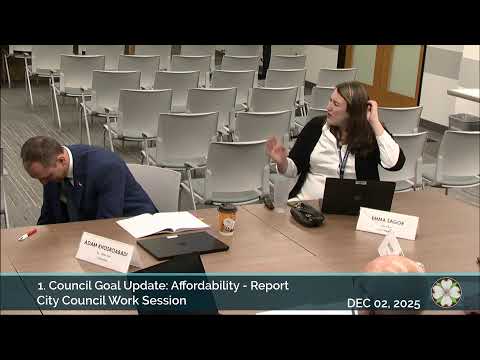
City staff told the council they will launch a citywide affordability survey next month, continue utility rate modeling (including scenarios that use a drinking-water revolving loan), expand billing-assistance outreach and update stormwater impervious-area data to make charges more accurate.
Emma opened the Dec. work session by calling this the quarterly update on the council affordability goal and introduced assistant city manager Joseph Virilio, public works director Peter Passarelli and finance director Michael Osborne as co-leads on the initiative.
"We hope to launch the community survey next month and get that going in the first quarter and get that wrapped up to you in the second quarter to share results prior to the budget conversations," Joseph Virilio said. Staff said the survey will repeat most questions used previously so the city can measure trends over time and will also include a few new questions to reflect current priorities.
On the utility side, Public Works Director Peter Passarelli said the city's rate consultant met Nov. 3 with the community utility advisory committee to review a set of water-rate scenarios. Passarelli said staff are modeling rate-revenue scenarios that include potential financing from the Drinking Water Revolving Loan Fund to understand how different funding mixes would affect customer rates and the capital program.
Passarelli described efforts to "rightsize" the capital improvement program so that large projects can be spread across multiple years rather than concentrated in single budget cycles, which staff said should reduce the need for large, sudden rate increases. He also said staff are reviewing available funds — utility reserves, system development charges and grants — and the city's capacity to deliver projects.
Finance Director Michael Osborne described outreach steps the finance team has taken to help customers. He praised Amy, a utility-billing customer-service staffer, who led the city's first utility-billing assistance night where roughly four to five residents attended and two had significant needs. "She is a real asset to the city," Osborne said, and staff said they plan additional assistance nights timed with low-income program renewals.
Staff acknowledged administrative constraints: the city currently has one customer-facing utility-billing staffer responsible for billing changes and customer service, and managers signaled that additional capacity (staffing) may be needed in future budget cycles to reduce single-person dependency.
On stormwater billing accuracy, staff said the city's impervious-surface data has gaps (the last comprehensive update was from 2019). They expect Metro to provide updated data in 2026 and plan to incorporate that data into the city billing system so charges better reflect current site conditions across the entire city. Councilors suggested exploring incentives tied to depaving and tree planting to reduce impervious area on underused parking lots near Johnson Creek.
The session closed with staff noting the timing: rate redesign work is expected to be discussed with the council beginning in March, with rate schedule adoption proposed alongside the budget adoption process in June.
Next steps: staff will launch the community survey, schedule additional billing assistance sessions, continue CIP rightsizing and present initial rate-design options beginning in March. PGE is scheduled to present on utility topics at the council's Dec. 16 meeting.