
Haddon Township reports rising special-education caseloads, opens new in-district programs
Get AI-powered insights, summaries, and transcripts
Subscribe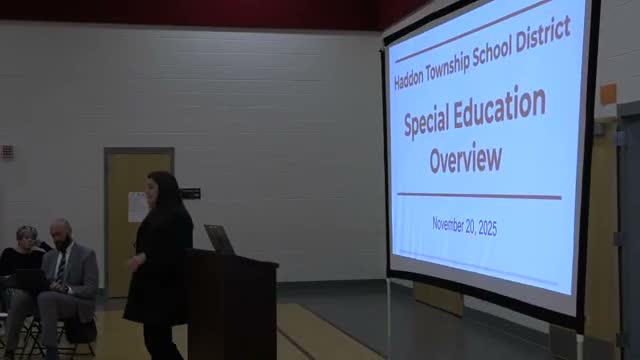
Summary
District special-education staff told the board that 389 students were classified this year and that the total likely will exceed 400 by year end, prompting new in-district classrooms, added supports and concern about rising related-service costs.
Haddon Township special-education staff told the Board of Education that classified student counts have risen to 389 and are expected to surpass 400 by the end of the school year, prompting the district to open new in-district programs and to expand services.
"We anticipate will probably be over 400 by the end of the school," Speaker 7 said while presenting department goals, data and staffing needs. The presenter described statewide changes to classification language and meeting notices and said the department is investing in professional development and updated assessments to align with new state versions of tools.
Why it matters: An increasing special-education caseload affects staffing, space and budgets. Speaker 7 described a continuum of services the district uses — inclusion classes with co-teachers, resource pull-outs, self-contained classes and out-of-district placements — and said the goal remains placement in the least restrictive environment appropriate for each student.
Details from the presentation: Speaker 7 said about 15 students are typically in evaluation at any one time; the district has roughly 26 students in self-contained preschool classes, 36 in self-contained language/learning or multiple-disabilities classes, and about 236 students served primarily in inclusion or small-group settings. The presenter credited staff and after-school supports with five students returning from out-of-district placements in the past two years and noted the district opened three new in-district programs over the past three years, including multiple-disabilities and language-learning classrooms at Van Sciver Elementary School.
Speaker 7 also highlighted practical supports, noting a student who uses an augmentative communication device "that needs her device there so she can talk while she is, engaged in the community," and described life-skills and pre-vocational classes that teach social and task-related skills and include community-application projects. The presenter said these classes are not direct job training but aim to build independence and social application.
Budget and capacity concerns: The presentation warned that some related-service costs — one-on-one aides, specialized equipment and external placements — are rising at rates that exceed the typical 2% tax increase. "We are looking at cost increases that might be more than 2% every year," Speaker 7 said, adding that precise percentages vary by service and placement.
What comes next: The district is continuing professional development and data analysis to implement the new state guidance on classification and transition services; no formal board action on funding was recorded during the meeting. The board entered executive session after the presentation.