
Special‑education enrollment rises to 4,348; district sets 'meets' targets
Get AI-powered insights, summaries, and transcripts
Subscribe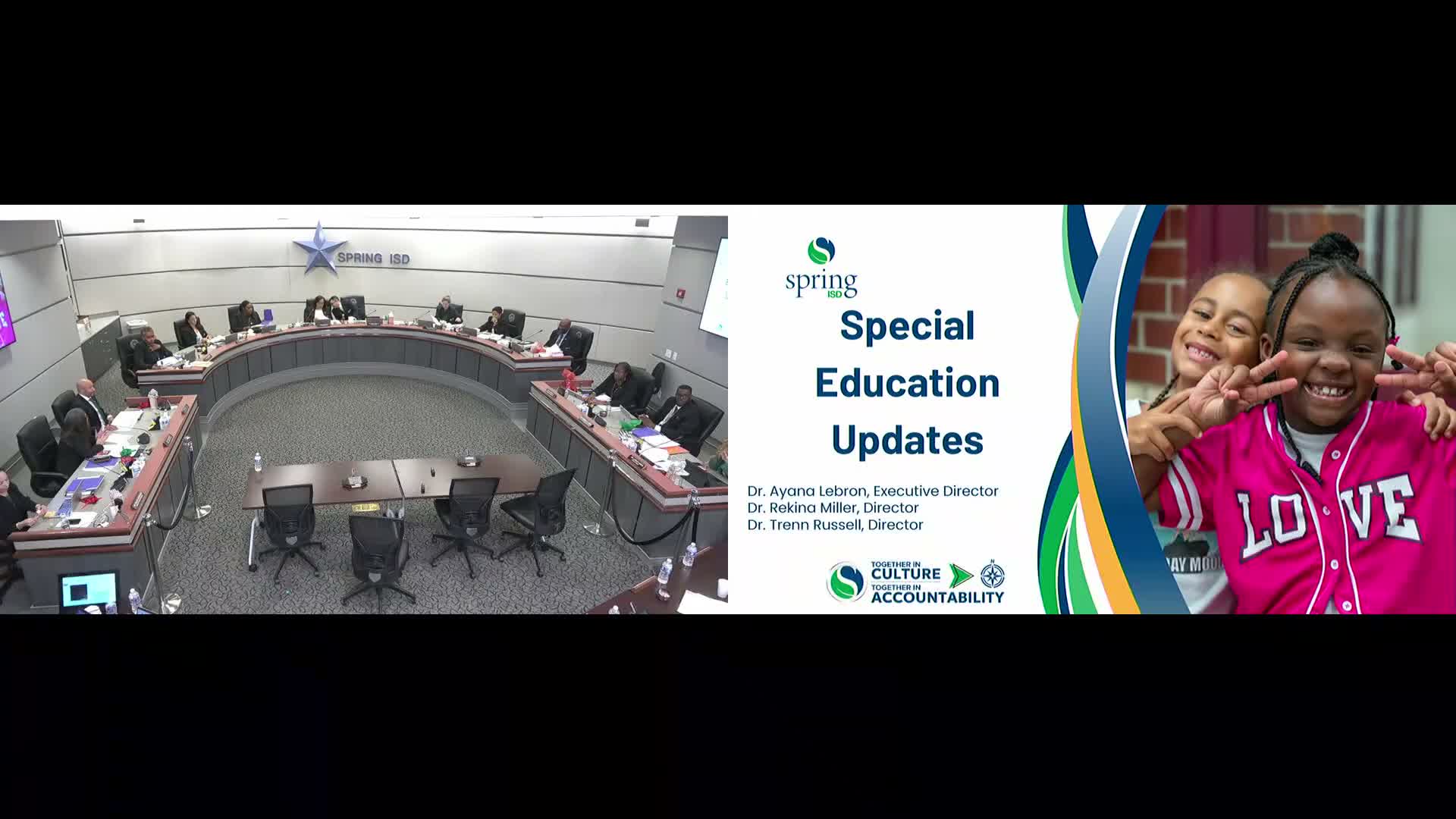
Summary
Spring ISD officials reported 4,348 students receiving special education (about 13% of enrollment), described training and inclusion efforts, and set normalized growth targets to raise 'meets' percentages in math and ELA.
Spring Independent School District leaders told the board Dec. 9 that special‑education enrollment is increasing and that the district is taking specific steps to narrow performance gaps.
Dr. Lebron reported that the district counted 4,348 students receiving special education as of Nov. 11, 2025 — roughly 13% of the student population — and said about 85% of those students are educated in the general curriculum with accommodations and supports. The Special Education Department noted attendance and discipline trends and said it is working with student affairs to address disproportionate removals of Black students who receive special education services.
District data show special‑education students perform below the general population on many unit assessments: the presentation noted 'meets' rates of 19% in math and 17% in English language arts for the special‑education subgroup. Using the district’s normalized growth model, Dr. Lebron said the department’s targets are to reach 27% at the 'meets' level in math and 25% in ELA over planned growth trajectories.
Dr. Russell outlined action steps including targeted training (a recent session engaged about 340 special‑education teachers), PLAAFP (present level of academic achievement and functional performance) alignment to drive effective IEPs, monthly coordinator‑to‑principal reviews of unit assessment data, and community events such as an "all‑abilities fair." The department acknowledged interim teachers fill many slots and said interim staff are required to take the same training as certified teachers; coordinators will continue monthly follow‑up and monitoring.
Trustees asked whether the district has adequate staff to deliver IEPs and whether interim teachers may participate in IEP meetings (administration said interim teachers may attend IEP meetings but cannot sign as the certified staff member). Trustees pressed for more longitudinal data (e.g., how many students exit special education over time) and for trend comparisons across years in future reports.
What’s next: Special education leaders will return with more longitudinal trend data and follow‑up plans to address disproportionate discipline removals and to strengthen implementation monitoring.