
Senate subcommittee presses FAA on use of $12.5 billion down payment, integrator contract with Peraton
Get AI-powered insights, summaries, and transcripts
Subscribe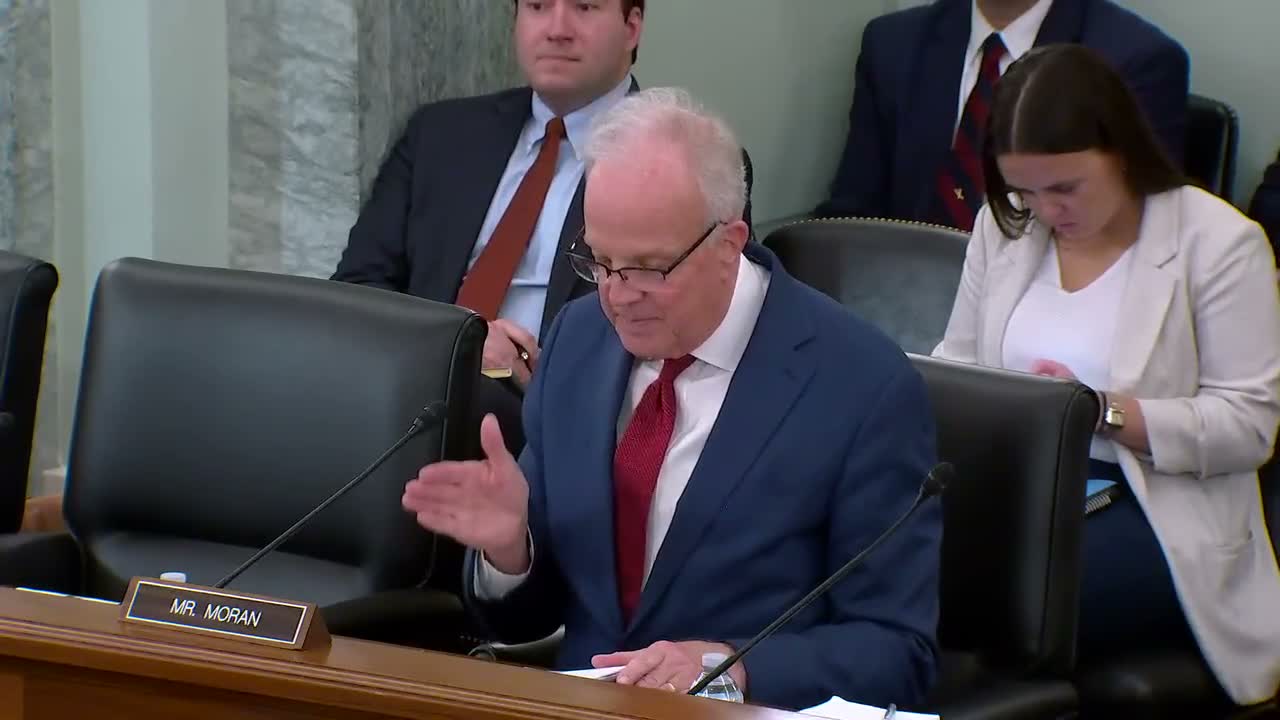
Summary
Senators pressed FAA Administrator Brian Bedford on how the $12.5 billion congressional down payment and a separate $5 billion appropriation are being used to modernize air-traffic-control systems, the timing to obligate funds, and the structure of the integrator contract awarded to Peraton.
The Senate Commerce Subcommittee on Aviation and Space on Thursday pressed Federal Aviation Administration Administrator Brian Bedford for details about how Congress's $12.5 billion down payment on air-traffic-control modernization has been and will be spent, and about the terms of the newly announced prime integrator contract with Peraton.
Chairman Moran opened the hearing by calling the January 29 midair collision that killed 67 people a catalyst for action and asking Bedford to explain how the authorized funds are being used. "By the end of the year, I expect we'll have 6 to 6 and a half billion dollars of the 12 and a half actually earmarked and contractually under obligation for telco modernization, surveillance modernization, and digitizing voice communications," Bedford replied.
Why it matters: Congress provided a historic down payment to speed a once-multidecade modernization effort; lawmakers want clear milestones, durable redundancy and assurance that today's sustainment needs do not absorb money intended for long-term digital upgrades.
Bedford described an approach that compressed a previously 20-year telecom modernization plan into roughly 2'1/2 to 3 years, saying the FAA has moved more than 950 facilities from copper to fiber in the prior months and that over a third of copper infrastructure has been removed. He cautioned that appropriations funding often goes to sustainment tasks — "85 to 90% of those funds actually go to sustaining, repairing, painting, replacing elevators, and HVAC systems" — while the reconciliation funds are intended to advance the analog-to-digital transition.
On the role of Peraton, Bedford said the integrator arrangement breaks Peraton's profit into a fixed 3% element and a variable up to 6% tied to completing defined "needs packages" on budget and on time; the FAA will withhold 3% for potential damages tied to noncompliance. "So it's a very strenuous agreement, and we have, vigilant oversight on it," Bedford said.
Committee members repeatedly asked about the next tranche of funding and whether the FAA's accelerated schedule risks operational gaps. Ranking Member Duckworth and others told Bedford they want explicit milestones and stronger transparency after prior modernization efforts produced cost overruns and schedule slippage. Bedford said the agency has developed 14 critical work packages and an "articulable strategy" and that achieving a cloud-based, consolidated automation platform would require an additional tranche of funding.
On specific procurement timelines, Bedford said the FAA has down-selected three radar vendors and expected to award contracts within weeks, with installations beginning in 2026 to meet a June 2028 replacement target for up to 612 radar systems. He also described the Common Automation Platform plan to lift local compute power into a consolidated cloud architecture to reduce handoffs and centralize surveillance.
The hearing concluded with the chairman giving the administrator until Jan. 7 to answer written questions submitted for the record. Senators signaled close oversight going forward and urged that funds be aligned to clear, measurable milestones before more appropriations are committed.