
Model Home Energy Score ordinance advances but jurisdictions move at different paces; state bill referenced
Get AI-powered insights, summaries, and transcripts
Subscribe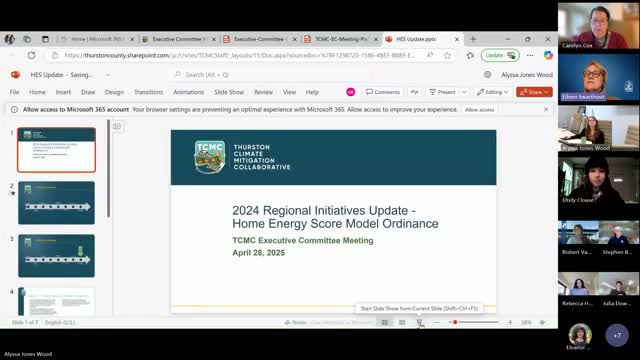
Summary
Staff updated the executive committee on a model Home Energy Score ordinance: Olympia has studied it, Tumwater and Thurston County are addressing legal and staff‑capacity questions, and Lacey placed the item on its 2026 work plan; staff noted enabling legislation (HB 1015) incorporated model‑ordinance language.
The Thurston Climate Mitigation Collaborative executive committee received an update April 28 on a regional model Home Energy Score ordinance and the different timelines jurisdictions face for adoption.
Alyssa Woods, who led the staff presentation, said the interlocal agreement process is at its last step — "consideration for adoption" — but that jurisdictions are at different points: Olympia presented the model ordinance at a land‑use committee and a council study session but has not scheduled adoption; Tumwater is holding internal discussions and city leadership expressed legal concerns about enforcement and coverage of homes not listed in Northwest MLS; Lacey placed the item on its 2026 work plan because staff time for 2025 is committed to its comprehensive plan; Thurston County provided an email brief to commissioners in 2024 but has not held a work session.
Committee members discussed enforcement mechanics and potential pathways if jurisdictions adopt at different times. Robert Vanderpool said embedding the Home Energy Score field into MLS forms can effectively require disclosure because most property listings are posted via MLS; staff confirmed that even if enabling state legislation passed, local ordinances would still be required for jurisdictions to make scores mandatory.
Woods also said staff met with the bill sponsor and that substitute language based on the regional model ordinance had been incorporated in the prior session’s draft. The meeting transcript referenced the bill as "HP 1015" during discussion; staff supplied the bill label "1015" in response to a request for the number. The model ordinance effort will continue while staff provide jurisdictions with pathways and legal clarifications so local governing bodies can consider adoption on their own timetables.
Next steps: staff will provide additional materials clarifying enforcement options and pathways for staggered or single‑jurisdiction adoption and will continue outreach to council bodies across the partner cities and county.