Galloway Township board adopts tightened library materials policy after extended public comment
Loading...
Summary
After extensive public testimony and board debate, the Galloway Township Public School District board adopted Policy 2,535/10.9 (Library Materials) in a 7–1 roll-call vote; the policy formalizes a challenge process and emphasizes case-by-case review and evidentiary criteria for removal.
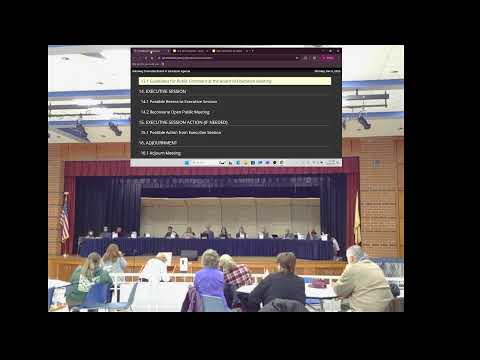
The Galloway Township Public School District Board of Education approved a revised Library Materials Policy (Policy 2,535 / 10.9) on Dec. 9 following extended public comment and a lengthy board discussion. The motion passed by roll call, 7–1.
The vote followed remarks from members of the public and a policy committee presentation. Sean Hyland of the New Jersey Family Policy Center urged the board to “adopt age appropriate standards and criteria” and to use objective written standards so decisions “are based on age appropriateness not on the identity of an author or the viewpoint expressed.” Several parents and community members pressed for clearer take-home information and assurances that the committee process would be accessible.
Policy committee chair Mrs. Chester told the board the committee met Dec. 4 to review edits and recommended the policy for a second and final reading. In committee deliberations and in open session, board counsel and one board member repeatedly stressed the need to balance students’ First Amendment access to library materials with parental concerns. The attorney referenced Island Trees Union v. Pico, the Supreme Court decision on student access to library materials, and explained that the policy frames a process to handle challenges without imposing a blanket pre-review of all collections.
Attorney/board counsel said the policy adds an evidentiary basis and a structured review so that ‘‘if a book is going to be taken from our libraries, it will be stated clearly why’’ and that determinations would allow for meaningful review by subsequent authorities. Supporters on the board described the revised policy as a more rigorous, transparent process than the template language they had been offered.
Opponents and some public commenters sought explicit, written age categories or a parent-review committee that would pre-screen books for appropriateness. Mrs. Herminell cast the lone dissenting vote in the final roll call, saying she sought clearer age-appropriate guidelines for parents and more accessible complaint routes. In the roll call, Mrs. Chester, Dr. Permenter, Mrs. Avery, Mr. Dace, Mr. Gentile, Vice President Bechara Blau and President Suzette M. Carmen voted in favor.
The policy as adopted preserves a challenge-driven review process: challenges are triggered by an individual request, are referred to a committee of defined stakeholders, and are evaluated with documented criteria about where and why a book was originally placed in the collection. The board and counsel said the approach aims to reduce litigation risk by documenting reasons for decisions and ensuring an auditable record.
What happens next: the district will implement the adopted policy and its challenge procedures. The policy text included references to state statutes and to the district’s established committee membership and timelines; the board did not amend the policy’s challenge procedure during the final vote. President Suzette M. Carmen thanked departing members and closed the discussion before moving to other business.