Get Full Government Meeting Transcripts, Videos, & Alerts Forever!
Get email alerts on the Traffic Calming topic
No spam. Unsubscribe anytime.
South Pasadena staff previews neighborhood traffic‑calming toolbox ahead of January council review
Summary
Public works staff presented a 19‑tool traffic‑calming toolbox drawn from FHWA and ITE guidance and told the commission it will be shared with City Council in January; staff said intrusive measures will require neighborhood petition thresholds and community meetings before installation.
City of South Pasadena public works staff on Dec. 10 presented a Neighborhood Traffic Calming Toolbox that compiles 19 measures—drawn from Federal Highway Administration and Institute of Transportation Engineers guidance—to reduce vehicle speed and volume in residential areas.
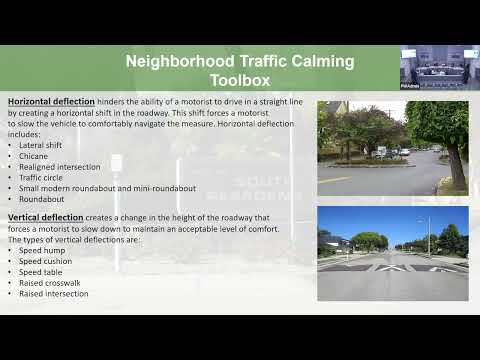
Chad Wilson, who introduced the item to the Public Works & Infrastructure Commission, said the toolbox is being presented to give commissioners an opportunity to comment before staff brings it to City Council in January. Bassam, the staff presenter, said the toolbox groups measures into four categories—horizontal deflection, vertical deflection, street‑width reductions and routing restrictions—and includes examples, typical applications, advantages, disadvantages and rough cost ranges.
"The traffic calming e‑primer resulted in a toolbox that is nationally used by literally all major public agencies in the country," Bassam said, adding the measures reflect decades of U.S. practice. He gave cost examples: roundabouts ranging from about $300,000 to $2 million per location, small/mini roundabouts $50,000–$150,000, speed cushions $12,000–$18,000, and raised intersections around $100,000.
Commissioners focused questions on applicability and process. Commissioner Sharma asked which tools can be used on South Pasadena’s narrow, hilly streets; staff replied some devices—such as speed humps and cushions—cannot be used on slopes greater than about 8 percent, but other options (striping, chokers, selective parking) can be applied in tighter corridors.
On implementation, staff said the toolbox is intended as a guideline inside a larger Neighborhood Traffic Management Program (NTMP). "When the NTMP is adopted by council, that becomes the umbrella policy," Bassam said. For intrusive measures, staff described a neighborhood petition process and community meetings, noting some installations have required neighborhood approval petitions (commonly about 75 percent support from both sides of a street) before staff proceeds to design and construction.
Vice Chair Brunell and others urged staff to simplify technical language for public presentations and to consider demonstration or pilot projects to give neighbors a chance to experience measures before permanent installation. Several commissioners also recommended that staff provide clear funding and phase information when the toolbox is presented to Council so residents do not read the toolbox as a guarantee of immediate construction.
Staff said it will take commissioner input into the January Council presentation and return with more detailed materials if the commission wants deeper review of individual tools.
The commission took no formal action on the toolbox at the meeting; staff said it will present the toolbox to Council next month and continue to refine the NTMP for later adoption.