Get Full Government Meeting Transcripts, Videos, & Alerts Forever!
Get email alerts on the Dual Enrollment topic
No spam. Unsubscribe anytime.
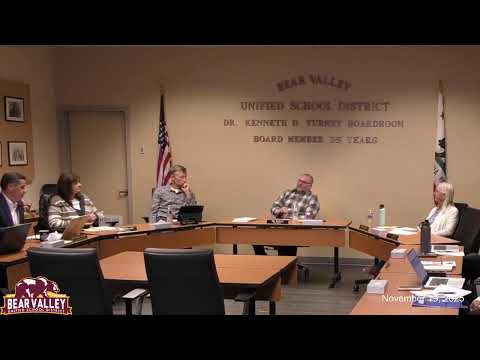
Crafton Hills College outlines dual-enrollment expansion for Bear Valley Unified
Summary
A Crafton Hills College representative told the Bear Valley Unified School District board that expanding dual enrollment can increase college access and equity for mountain-area students, described possible center thresholds and teacher stipend proposals, and offered to provide aggregated enrollment data.
Dr. Moran, a representative of Crafton Hills College, told the Bear Valley Unified School District board that expanding dual enrollment can make higher education accessible “at no cost” to students and described three delivery models the colleges use: standard dual enrollment (on campus or online), CCAP agreements offering classes on high-school campuses restricted to high-school students, and concurrent-enrollment classes offered outside the school day that must remain open to the public.
The presenter said slides showed the number of full-time-equivalent students from the mountain ZIP codes as “a little over 300” FTE and that high-school students in dual-enrollment classes have higher success rates than their college-age peers, with Hispanic and Black students in the program performing at higher rates in the data he presented. “Dual enrollment at its core is the way to make higher education accessible to students at no cost,” the presenter said during the talk.
Board members asked whether UC and CSU campuses accept credits for STEM majors; the presenter said institutions may require additional coursework for highly impacted majors but cannot deny valid credits, and that transfers from community colleges to UC/CSU generally have higher completion rates. The college representative said the district and colleges can track applications to UC/CSU and later enrollments, but such tracking is delayed by a few years and private‑school outcomes are harder to follow. The presenter offered to provide aggregate ZIP-code or school‑level statistics to the district rather than individual student grades, citing FERPA limitations.
Staff and the presenter discussed staffing dual-enrollment classes and a teacher-pipeline idea: because California community-college minimum qualifications are set by the state, the college is exploring a partnership with CSU San Bernardino to help K–12 teachers earn required graduate units or an equivalency. That proposal could include a stipend to cover remaining graduate‑level coursework in exchange for teachers committing to teach dual‑enrollment classes at their school sites.
The presenter described thresholds and funding for a potential physical center in the mountain area: community-college centers often target roughly 500 FTE students to qualify for center status, and the transcript cited approximately $1,500,000 as the basic portion of state allocation associated with center status. District staff reported 157 students currently enrolling through the college in the program; board members noted that represents a substantial share of the high school population and said enrollment is expected to grow as cohorts expand.
Next steps recorded in the meeting: the presenter offered to provide aggregated enrollment and outcome data (by ZIP code or by school) for the district, and staff agreed to continue coordinating schedules and program logistics. The presenter also said he is willing to return to provide additional information and to work with district staff on rollout timing.