Get Full Government Meeting Transcripts, Videos, & Alerts Forever!
Get email alerts on the School Finance topic
No spam. Unsubscribe anytime.
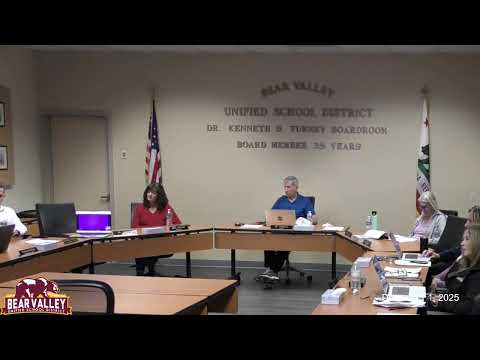
Bear Valley Unified board approves first interim financial report; projected deficit improves to about $1.4 million
Summary
The Bear Valley Unified School District board approved its first interim financial report for fiscal year 2526, reporting improved deficit projections driven by new state block grants and one-time revenues while cautioning about a funding cliff and reliance on grant-funded positions.
Bear Valley Unified School District trustees on Monday approved the district's first interim financial report for fiscal year 2526, with presenters saying the district's projected deficit has narrowed from roughly $2.9 million at adoption to about $1.4 million.
The report was presented by Speaker 2, who said the district must certify its fiscal condition twice each year and that this was the first interim. "First interim for 2526, we're maintaining a positive certification," Speaker 2 said, adding that overall revenues reported for the fiscal year increased by about 7 percent.
Why it matters: the interim report shows how one-time or nonrecurring revenues and shifts in restricted-program spending are affecting the district's near-term solvency. Speaker 2 told the board that state funding increases — notably in the Expanded Learning Opportunities Program (ELOP) and a new student services and professional development discretionary block grant of roughly $600,000 — along with increases in some federal grant activity (including a CSI grant for Chautauqua) helped offset a shortfall in Title I revenue that was about $120,000 lower than expected.
Key details from the presentation included projected enrollment of 2,160 and an adopted ADA projection of 1,998.3; Speaker 2 said current CBEDS-era ADA was about 1,975 and that recent attendance months showed improvement toward 94 percent. The presenter attributed higher certificated and classified salary costs to adding staff under restricted programs (CSI, LREBG learning recovery supports, Prop 28 music and arts), and reported increased capital outlay tied to a new portable building at North Shore Elementary paid from ELOP funding.
Speaker 2 summarized the fund balances and nonrecurring items that influenced the improved projection: beginning restricted balances were shown at about $9.3 million, the ending balance including restricted portions at about $7.8 million, and the restricted portion itself about $5.1 million. "We're looking better now with a $1,400,000 deficit," Speaker 2 said.
Board members asked for follow-up details and clarity on sustainability. Joseph Mayning asked how many certificated and classified employees are paid from grants rather than the general fund; Speaker 2 said the district did not have that number on hand and would provide it to the board. Board members and staff discussed planning for attrition and potential placement of grant-funded employees back into site roles if external funding ends. Speaker 2 said the district is pursuing partnerships and other grant sources to sustain positions funded through CCSPP and related grants.
The report also covered the Redevelopment Agency (RDA) fund and related capital work. Speaker 2 said architect and inspection fees had been incurred for a stadium restroom project and that plans would be submitted to DSA this week. Board members asked for a multiyear deferred-maintenance/project list so that RDA spending is clearly tied to school improvements rather than appearing to "dribble away." Speaker 1 requested the multiyear list be prepared and presented to the board.
On debt questions, the presenter said measured-Q bond-related debt service and a lease-leaseback for solar panels are ongoing; the solar payoff was believed to be 2029 pending confirmation, and Speaker 2 offered to send the board a formal confirmation.
The board approved the first interim financial report by roll-call vote; Amber Fultz, Eric, Smart and Sequoia were recorded as voting "Aye," and Speaker 1 declared approval unanimous of members present. The approval follows a presentation that highlighted one-time revenue gains, increases in restricted-program staffing, and the district's ongoing need to plan for potential funding cliffs in subsequent years.
The board moved on with no further business recorded in the transcript.