
Bear Valley Unified formalizes library review process after community comments; district says no books were banned
Get AI-powered insights, summaries, and transcripts
Sign Up Free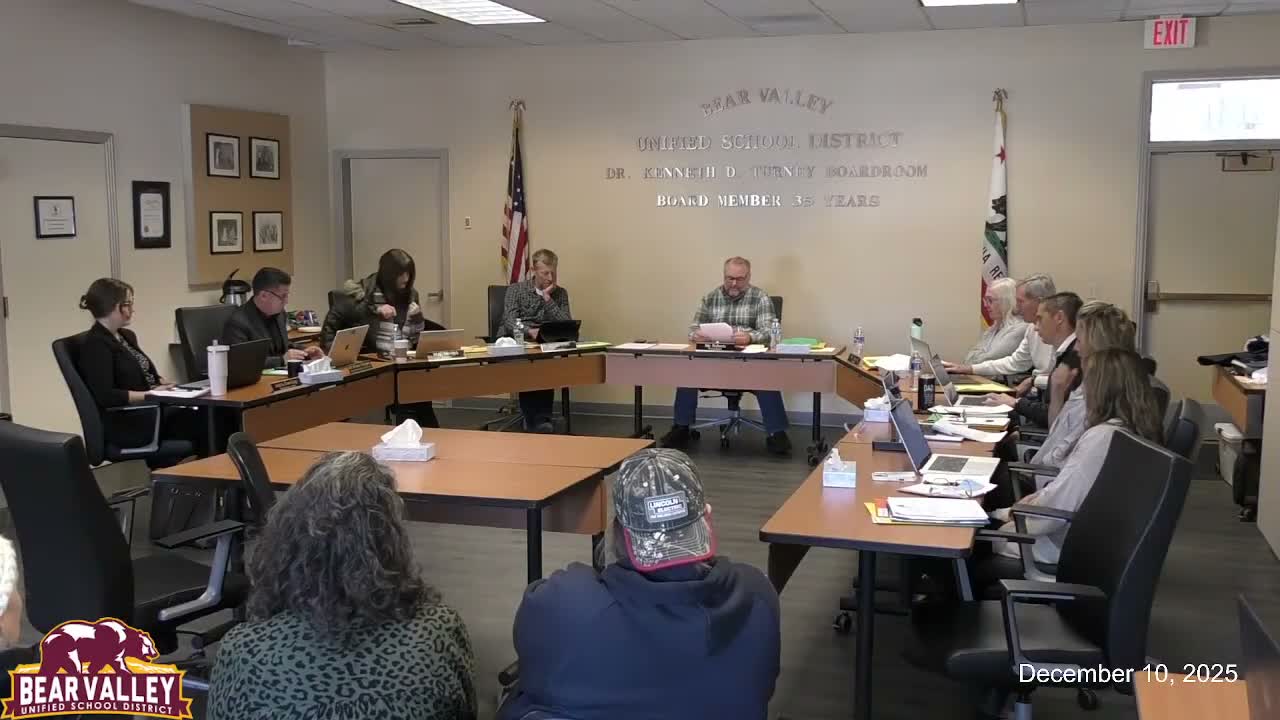
Summary
Board received a presentation formalizing library book-review procedures: librarians read whole titles, a quarterly library committee ranks material for age appropriateness, one book was relocated to high school and the district said that no books were banned; public commenters cited national book-ban data and urged access.
The Bear Valley Unified governing board heard a presentation on the district—s newly formalized library book-review procedures and took public comment from parents and community members during an extended discussion.
District curriculum staff (Speaker 4) said the district carried out a book study in 2024 that reviewed roughly a dozen titles and resulted in a small number of circulation adjustments. "From that book review, there were no books that were completely removed from the library... today we have not banned, any book," the presenter said. In one case a title was moved from the middle school collection to the high school collection based on the district—s age-appropriate guidelines.
The presenter described the process in detail: when a book is placed under review, the district—s library committee (including part-time teacher-librarians and site library clerks) reads the full text rather than an excerpt, applies grade-band criteria and ranks works on factors such as violence, explicit content, profanity, substance use and social-emotional intensity, and consults outside references (the state-adopted book list and Common Sense Media). The district also identified "protected areas" on library shelves for material it deemed appropriate only for older students; the transcript records cutoffs of about age 14 for middle-school-protected shelves and about 16 for high-school-protected shelves. For students younger than a protected cut-off, speakers described a parental-permission process: the default is no access without a signed permission slip.
Public commenters framed the issue sharply. One commenter (Speaker 8) warned that removing or restricting books risks cutting off students from resources they might need and urged the board to trust librarians and students. Another (Speaker 9) cited national data: "According to the group PEN America, 6,970 instances of book bans occurred in the 2024–25 school year alone," and argued that bans are often initiated by small, organized groups and can reduce representation and engagement for marginalized students. The district—s presenters and several board members responded by describing the committee-based review, the use of librarians— professional judgment, and the availability of the formal presentation and process for community review.
Board members asked operational and accountability questions: how many books were reviewed (about a dozen, per the presenters), whether books are judged on full context rather than isolated excerpts (presenters said yes), and how circulation or obsolescence is handled (the district will surplus antiquated titles based on usage metrics). The presenter said the committee meets quarterly to ensure consistency across sites.
No formal policy change or vote on a library policy was recorded in the public transcript; the district presented its procedures and answered questions. The board confirmed that the district will continue engaging community members and noted that the presentation is available online for review.
Next steps: the district will continue implementing the review process and communicate details to families; the board did not take formal disciplinary action or ban books during the public portion of the meeting.